Private Nile Cruise Egypt with Egyptologist Guide for a Unique Journey
A journey along the Nile becomes far more meaningful when you are given enough time to understand what you are seeing. Ancient temples, hieroglyphic inscriptions, royal tombs, riverside villages, Nubian culture, agricultural landscapes, and the changing scenery of Upper Egypt all tell different parts of the same story.
Choosing a private Nile cruise Egypt with Egyptologist guide gives travelers an opportunity to experience that story in greater depth.
Instead of moving quickly through archaeological sites as part of a large group, a private or intimate Nile journey creates more space for questions, discussion, photography, relaxation, and personal discovery. An expert Egyptologist can explain the history behind the monuments while the river itself connects one destination with another.
Royal Felucca creates carefully designed Nile experiences for travelers seeking privacy, historical depth, authentic Egyptian hospitality, and a slower way to discover Upper Egypt. With more than 14 years of sailing experience and over 2,400 guests welcomed, Royal Felucca combines personalized service, curated itineraries, premium comfort, local knowledge, and expert guidance.
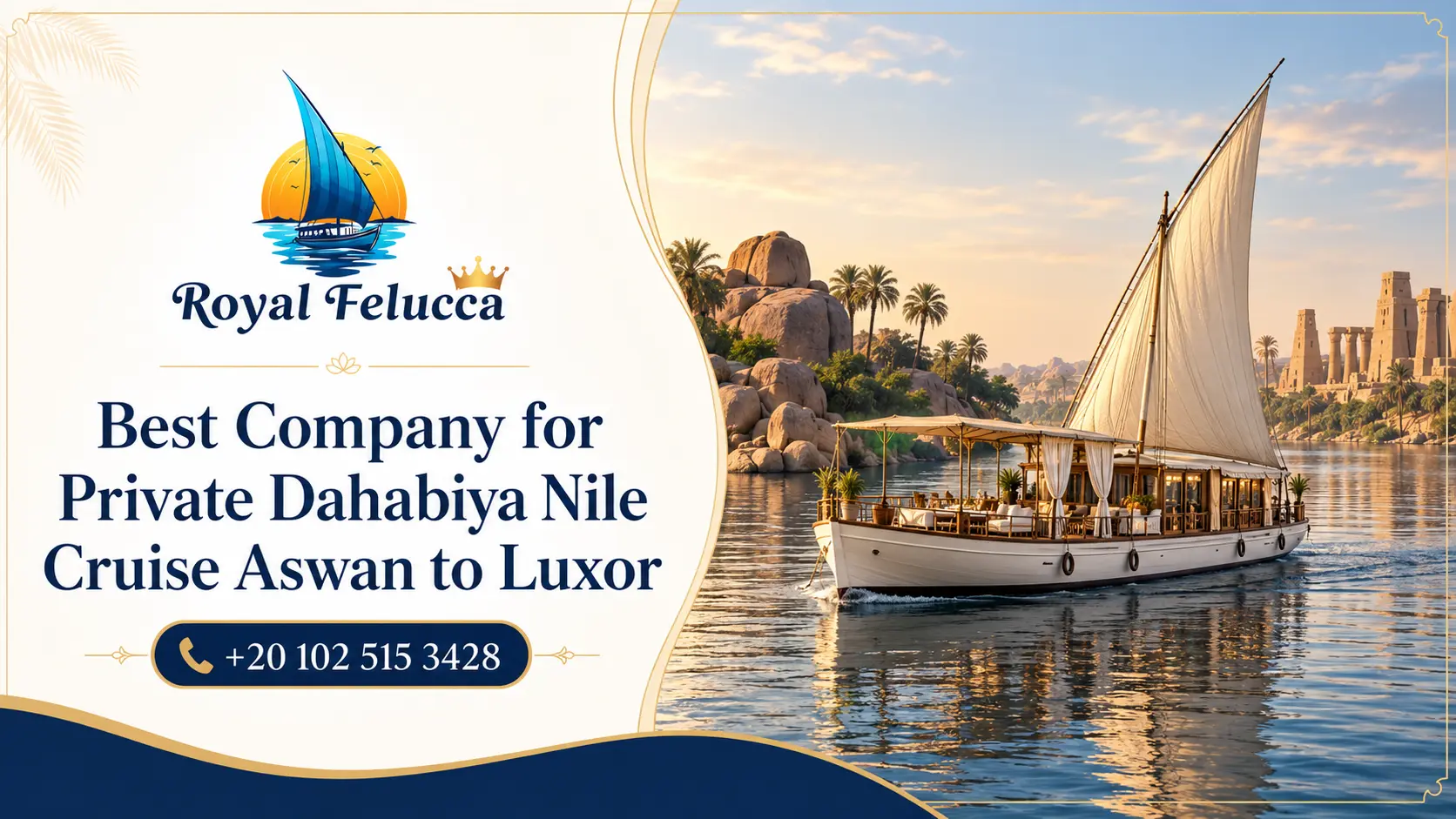
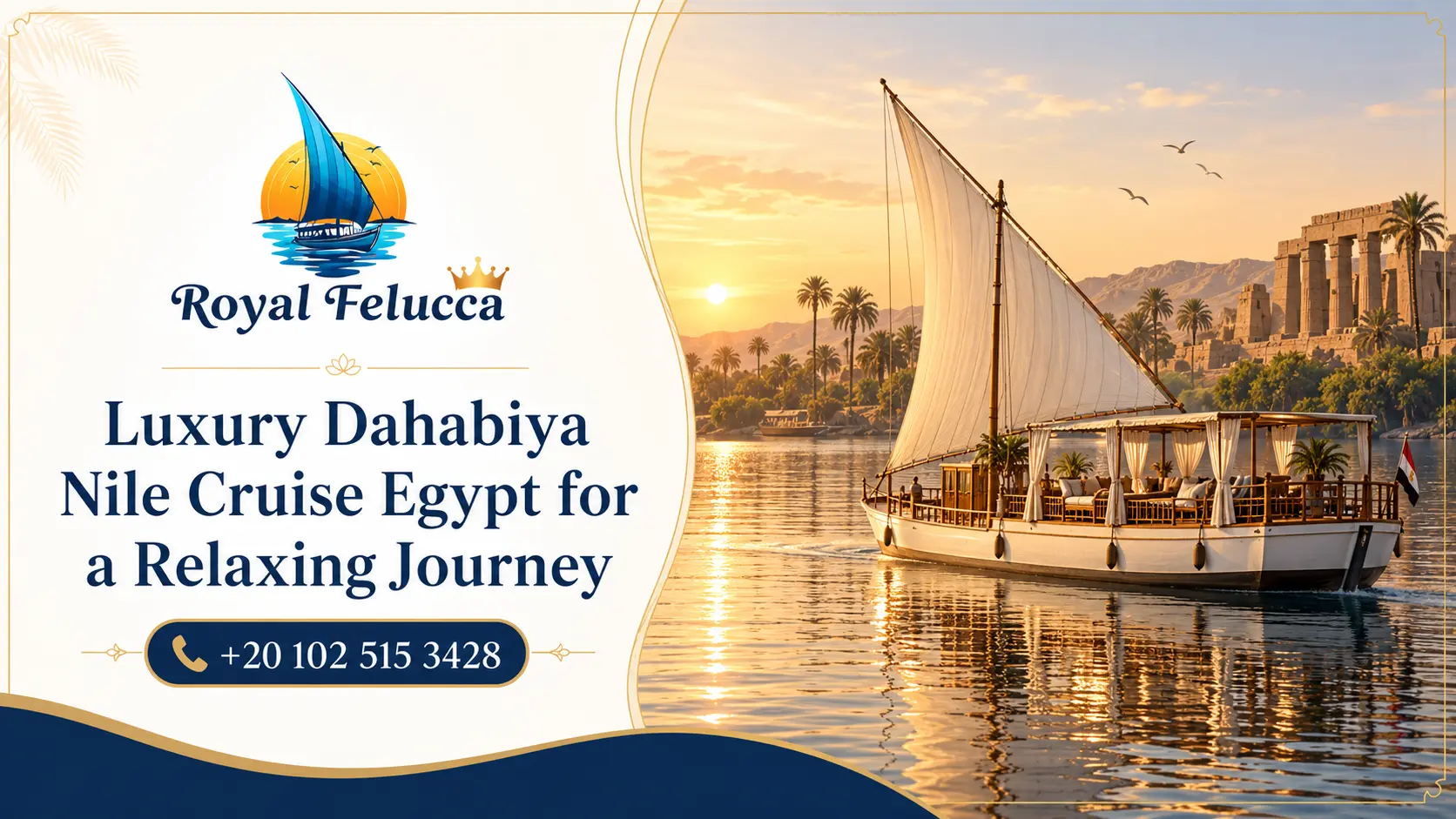
Its Dahabiya accommodates only twelve guests across six refined suites, providing an intimate alternative to large commercial cruise ships. For travelers who want something even closer to traditional Nile sailing, Royal Felucca also offers a private felucca experience centered on wind-powered travel, open-deck living, fresh onboard meals, and the landscapes of southern Egypt.
A private Nile journey with an Egyptologist is therefore about far more than moving between temples.
It is about understanding the civilization that created them while experiencing the river that made that civilization possible.
About the Private Nile Cruise Egypt With Egyptologist Guide Experience
A private Nile cruise combines sightseeing, accommodation, dining, transportation, historical interpretation, and relaxation within one continuous journey.
The difference is intimacy.
Smaller guest numbers create a calmer environment.
There is more opportunity to interact with the guide.
Meals feel more personal.
Time on deck becomes quieter.
Historical visits can be explored at a more comfortable pace.
Instead of simply following a fixed group schedule, travelers can experience Upper Egypt in a way that feels more closely connected to their interests.
Royal Felucca’s Dahabiya journey can include full-board dining, an Egyptologist guide, temple entrances, airport transfers, domestic flights, and in-suite amenities depending on the selected experience.
The result is a journey that combines historical discovery with the comfort and convenience of having many practical elements organized together.
Why Travel With an Egyptologist Guide?
Egypt contains some of the world’s most recognizable monuments, but seeing them is not the same as understanding them.
A temple wall may look beautiful from a distance.
An Egyptologist can explain what the carvings represent.
A royal tomb may be visually impressive.
A specialist guide can explain why certain scenes appear along the walls and what they meant to ancient Egyptians.
A statue may seem decorative.
An Egyptologist can identify the ruler, god, symbolism, and political meaning behind it.
This additional context can completely change the experience.
The temples stop feeling like isolated ancient ruins.
They become part of a larger historical story.
Turn Hieroglyphs Into Stories
Hieroglyphic inscriptions are everywhere at major archaeological sites.
Without guidance, most visitors see patterns and symbols.
With an Egyptologist, those details begin to reveal meaning.
Names of rulers.
Religious ceremonies.
Offerings to gods.
Royal titles.
Historical events.
Mythological scenes.
The walls begin to communicate.
This creates a much deeper connection with ancient Egyptian history.
Travelers are no longer simply looking at decorations.
They are beginning to understand what ancient people wanted those walls to say.
Learn Why Ancient Temples Were Designed the Way They Were
Ancient Egyptian temples were not random collections of halls and columns.
Their layouts had meaning.
Different spaces had different functions.
Some areas were more public.
Others became progressively more sacred.
Ceremonial routes were important.
Light, scale, architecture, and symbolism all contributed to the religious experience.
An Egyptologist can explain these details while you are standing inside the monument.
That immediate context often makes the information far easier to remember.
A Private Journey Gives You More Time to Ask Questions
One of the limitations of large group tours is that the guide must manage many different people at the same time.
The group needs to stay together.
Time is limited.
Individual interests can be difficult to explore.
A smaller Nile journey creates more opportunities for genuine conversation.
If you are fascinated by a particular pharaoh, you can ask about that ruler.
If you are interested in Egyptian mythology, you can explore the relationships between different gods.
If architecture interests you most, you can ask about temple construction and design.
The Egyptologist becomes part of the journey rather than simply someone delivering a prepared speech.
Begin the Journey in Aswan
Aswan offers one of the most beautiful environments on the Egyptian Nile.
The river flows between islands and granite formations.
Traditional feluccas move across the water.
Palm-lined shores frame the landscape.
Nubian communities add cultural depth.
The desert appears close behind the fertile riverbanks.
This setting immediately introduces travelers to the relationship between geography, culture, and history in southern Egypt.
A private Nile journey gives guests time to appreciate Aswan rather than treating the city only as a departure point.
Discover Philae With an Egyptologist
Philae is one of Aswan’s most memorable archaeological experiences.
The temple complex is associated with the goddess Isis and is surrounded by water, creating a striking setting.
Its columns, courtyards, inscriptions, and architectural details reflect important religious traditions.
With an Egyptologist, travelers can explore the mythology connected with Isis and understand why the temple held such significance.
The guide can also explain the meaning of particular inscriptions and the historical changes the site experienced over time.
Philae becomes more than beautiful architecture.
It becomes part of a larger religious story.
Experience Elephantine Island and the Aswan Landscape
Elephantine Island sits directly within the Nile and forms an important part of Aswan’s historical and geographical identity.
From the river, travelers can appreciate the island within the wider landscape.
Palm trees.
Traditional buildings.
River channels.
Granite formations.
Small boats.
The city beyond.
A smaller vessel creates a closer relationship with these surroundings.
You are not simply looking at Aswan from a distance.
You are traveling through it.
Discover Nubian Culture Along the Nile
Upper Egypt is not only about ancient monuments.
Nubian communities are an important part of the cultural identity of southern Egypt.
Their traditions, architecture, hospitality, and relationship with the Nile add another layer to the journey.
Travelers may experience colorful Nubian communities and river landscapes depending on the selected itinerary.
This creates valuable balance.
An Egyptologist helps explain the ancient past.
Local cultural experiences reveal the living present.
Together, they create a more complete understanding of southern Egypt.
Sail Through the Landscapes of Upper Egypt
Once the journey moves away from the larger cities, the Nile Valley begins to reveal a quieter side of Egypt.
Fields stretch beside the river.
Palm trees surround villages.
Traditional boats move between the banks.
Birds gather near agricultural land.
The desert remains visible beyond the cultivated strip.
These scenes are not empty travel time.
They help explain the importance of the Nile throughout Egyptian history.
The river supported agriculture.
Transport.
Settlement.
Trade.
Daily life.
Religion.
Experiencing this landscape while learning about ancient Egypt creates powerful historical context.
Understand Why the Nile Was Essential to Ancient Egypt
Ancient Egyptian civilization could not have developed in the same way without the Nile.
The river provided water and fertile agricultural land.
It connected communities.
It supported transportation and trade.
It shaped settlement patterns.
It influenced religious ideas and cultural traditions.
Traveling along the river makes these relationships visible.
You are not learning about the Nile in a museum far away from it.
You are moving through the landscape while your Egyptologist explains how the river shaped civilization.
Discover Kom Ombo
Kom Ombo is one of the most distinctive temple sites along the Nile.
Its riverside location creates a natural connection between archaeology and landscape.
The temple is particularly known for its association with Sobek and Horus.
Its unusual double character makes it different from many other ancient Egyptian religious sites.
Arriving as part of a Nile journey creates valuable context because travelers can immediately see how closely the site is connected with the river.
Explore Kom Ombo With Expert Guidance
An Egyptologist can help travelers understand the significance of the temple’s design.
Why two deities were honored.
How the spaces were organized.
What the reliefs represent.
How religion interacted with the natural environment.
The site becomes easier to understand once these relationships are explained.
Instead of simply taking photographs, travelers begin to recognize the meaning behind what they see.
Enjoy Kom Ombo in the Changing Light
Historical sites can feel very different depending on the time of day.
Later light can give Kom Ombo a particularly atmospheric character.
Ancient stone becomes warmer.
Shadows grow longer.
The Nile remains close.
The surrounding landscape becomes softer.
A carefully paced private journey allows time to appreciate the atmosphere rather than moving immediately to the next attraction.
Continue Toward Edfu
The journey through Upper Egypt continues between villages, fields, palms, boats, and desert horizons.
The spaces between the historical sites remain important.
Travelers can spend time on deck.
Ask their Egyptologist additional questions.
Review photographs.
Enjoy meals.
Observe everyday life.
The river creates continuity between each chapter of the historical journey.
Discover the Temple of Horus at Edfu
Edfu is home to one of the most impressive surviving temples in Egypt.
The Temple of Horus is known for its remarkable preservation.
Its monumental entrance creates an immediate sense of scale.
Inside, courtyards, halls, columns, chambers, reliefs, and inscriptions reveal the structure of an ancient temple with extraordinary clarity.
For history-focused travelers, Edfu can become one of the strongest experiences of the entire journey.
Understand the Mythology of Horus
An Egyptologist can explain the religious stories associated with Horus and how these ideas are reflected throughout the temple.
The carvings become more meaningful.
The architecture begins to make sense.
The relationship between different sacred spaces becomes clearer.
Travelers can also understand how religion and royal authority were connected within ancient Egyptian temple culture.
This context transforms Edfu from an impressive building into a much richer historical experience.
Return to the Peace of the Nile
One of the advantages of a private Nile journey is the contrast between archaeological exploration and river relaxation.
After spending hours inside an ancient temple, travelers can return to a quieter environment.
Lunch.
Tea.
The sundeck.
Conversation.
Rest.
There is enough time for the historical experience to settle.
This balance helps prevent temple fatigue and allows each major site to remain memorable.
Explore Luxor With Greater Historical Context
Luxor contains some of the most important archaeological landscapes in Egypt.
Monumental temples.
Royal tombs.
Statues.
Inscriptions.
Ceremonial complexes.
The scale of the history can be overwhelming.
Arriving after spending several days with an Egyptologist along the Nile gives travelers much more context.
By this stage, many of the gods, rulers, architectural ideas, and religious concepts are already familiar.
Luxor becomes the continuation of the story rather than a completely new subject.
Discover Karnak With an Egyptologist
Karnak is one of the great highlights of any Upper Egypt journey.
Its size is extraordinary.
Massive columns.
Gateways.
Courtyards.
Obelisks.
Statues.
Sacred spaces.
Inscriptions.
Different rulers contributed to the complex over long periods of history.
An Egyptologist can explain how these different elements fit together.
Without guidance, the site can feel overwhelming.
With expert interpretation, it becomes possible to understand the development and meaning of the complex.
Experience the Valley of the Kings
Across the Nile, the Valley of the Kings reveals another side of ancient Egyptian civilization.
The landscape is dry and dramatic.
Royal tombs are carved into the desert.
Inside, decorated chambers reveal ancient ideas surrounding death, kingship, rebirth, and the afterlife.
The paintings and texts were not simply decorative.
They had religious meaning.
An Egyptologist helps visitors understand these symbols and how ancient Egyptians imagined the journey beyond death.
Connect One Historical Site With Another
One of the greatest benefits of traveling with the same expert guide is continuity.
The guide can connect what you saw at Philae with themes that appear later.
Ideas introduced at Kom Ombo may become relevant at Edfu.
Architectural concepts can be compared between temples.
Religious beliefs can be traced across different regions.
Rulers and historical periods can be placed within a wider timeline.
Instead of remembering separate monuments, travelers begin to understand ancient Egypt as one connected civilization.
Enjoy a More Personal Historical Experience
Some travelers visit Egypt with a general interest in history.
Others have spent years reading about the civilization.
A private Nile journey can work well for both.
First-time visitors can receive clear explanations without becoming overwhelmed.
More knowledgeable travelers can ask deeper questions and explore specific interests.
This adaptability is one of the main advantages of smaller-scale guided travel.
Experience the Comfort of a Dahabiya
Royal Felucca’s Dahabiya offers a refined environment for travelers who want privacy and comfort alongside historical exploration.
The vessel carries only twelve guests across six suites.
This smaller capacity creates a quieter atmosphere than large cruise ships.
The suites include traditional and refined details such as arched windows, cane headboards, hand-woven textiles, quality linens, and thoughtful amenities.
After long mornings exploring temples, returning to a comfortable suite can make the journey significantly more enjoyable.
A Small Guest Count Changes the Atmosphere
Twelve guests create a very different environment from a vessel carrying large numbers of passengers.
The sundeck feels calmer.
Meals are quieter.
Service can be more personal.
There is more opportunity to talk with the guide.
Shared spaces never feel overwhelmingly busy.
For travelers seeking privacy, this limited capacity can be one of the most valuable aspects of the experience.
Enjoy Full-Board Dining
Royal Felucca’s Dahabiya Experience can include full-board dining.
This creates convenience and helps keep the journey connected.
Breakfast can begin with Nile views.
Lunch can be enjoyed while the landscape changes.
Dinner can take place beneath the evening sky.
Travelers do not need to repeatedly leave the vessel or organize restaurant arrangements independently.
The dining experience remains part of the journey.
Meals Create Time for Conversation
Meals can also become an extension of the historical experience.
After visiting a temple, travelers may continue discussing what they saw with the Egyptologist.
Questions that arise after leaving the archaeological site can still be explored.
This creates a more relaxed learning environment.
History is not limited to the hour spent inside the monument.
It becomes part of the wider journey.
Relax on the Sundeck
The sundeck provides a natural place to slow down.
Travelers can sit with a book.
Drink tea.
Take photographs.
Talk with other guests.
Ask the guide more questions.
Or simply watch the river.
The changing landscape provides its own entertainment.
Fields.
Villages.
Boats.
Birds.
Palms.
Desert horizons.
These quiet periods are an essential part of the Nile experience.
Watch Sunset Over the River
Sunset can become one of the most memorable daily moments.
The strong afternoon light begins to soften.
The Nile reflects warmer colors.
Palm trees turn into silhouettes.
Traditional boats move against the changing sky.
Villages become quieter.
On an intimate vessel, the atmosphere remains calm.
There is no need to compete with a large crowd for the best position.
Dinner Beneath the Stars
Evenings offer a different kind of luxury.
The river becomes quieter.
The sky becomes more visible.
The intensity of the day disappears.
Dinner beneath the stars creates a natural conclusion to a day of historical exploration.
There is time to talk about what you learned.
Time to enjoy the surrounding silence.
Time simply to appreciate where you are.
Wake Up Without Changing Hotels
One of the practical advantages of a Nile cruise is that your accommodation moves with you.
You do not need to repeatedly pack your luggage.
Check out.
Transfer to another hotel.
Check in again.
Instead, you can wake to a new Nile landscape while remaining in the same suite.
This continuity makes a multi-destination journey through Upper Egypt significantly more comfortable.
Privacy Makes the Experience More Relaxed
A private or intimate journey offers more than physical space.
It creates mental space.
There are fewer distractions.
Less noise.
Smaller groups.
More personal conversations.
More room for photography.
More time with the guide.
For travelers who dislike mass tourism, this difference can strongly influence the quality of the trip.
A Private Nile Cruise for Couples
Couples often appreciate the atmosphere of smaller-vessel travel.
Private accommodation provides personal space.
Historical visits become shared discoveries.
The sundeck creates time to relax together.
Sunset adds a romantic dimension.
Dinner beneath the stars provides another memorable setting.
For honeymoons, anniversaries, or meaningful trips together, a private or intimate Dahabiya can create a strong balance between culture and romance.
A Private Nile Cruise for Families
Families can also benefit from traveling with an Egyptologist.
Ancient history can become far more engaging when it is explained through stories rather than only dates.
Children and teenagers may find mythology, kings, tombs, hieroglyphs, and temple architecture particularly interesting when presented in an accessible way.
The sailing periods also provide valuable rest between historical visits.
Parents benefit from the convenience of staying settled onboard rather than changing hotels repeatedly.
A Private Nile Cruise for Friends and Small Groups
Friends traveling together can enjoy a more cohesive experience on a smaller vessel.
The group can explore historical sites together.
Ask questions together.
Share meals.
Relax on deck.
Discuss what they have learned.
Because the environment remains intimate, the journey feels more personal than joining a large commercial tour.
Photography Lovers Benefit From Expert Context
Upper Egypt offers extraordinary photography opportunities.
Temples.
Columns.
Reliefs.
Hieroglyphs.
Palm-lined riverbanks.
Traditional boats.
Villages.
Desert landscapes.
Sunset.
Morning light.
An Egyptologist can also help photographers understand the subjects they are capturing.
A photograph of a relief becomes more meaningful when you know the story behind it.
Personalized Service Makes the Journey Unique
Every traveler approaches Egypt differently.
Some are fascinated by ancient religion.
Some care most about royal history.
Others are photographers.
Some want cultural experiences.
Some want privacy.
Some want long periods of relaxation.
Royal Felucca focuses on personalized service so the wider journey can reflect guest interests and rhythm.
This helps the experience feel less standardized.
Authentic Egyptian Hospitality Adds Another Dimension
Hospitality plays an important role in the overall atmosphere.
Royal Felucca focuses on warm, genuine, and unhurried Egyptian hospitality.
Travelers spend multiple days with the crew, guide, and local team.
These interactions can become an important part of the experience.
The journey feels less like moving through a tourism product and more like being welcomed onto the Nile.
What Can Be Included in a Royal Felucca Dahabiya Journey?
Royal Felucca’s Dahabiya Experience can include full-board dining, domestic flights, an Egyptologist guide, temple entrance fees, airport transfers, and in-suite amenities.
Bringing these elements together can simplify a wider Egypt itinerary.
Travelers spend less time coordinating separate bookings.
Guiding is integrated with the historical visits.
Transfers become smoother.
Meals remain connected with the journey.
The practical side of travel becomes easier.
Consider the Traditional Felucca Experience
Travelers who want an even simpler relationship with the Nile can consider Royal Felucca’s traditional private felucca experience.
This journey focuses on wind-powered sailing without an engine and without unnecessary rush.
The experience can include private charter, fresh onboard meals, an Egyptologist guide, transfers, temple entrances, bedding, and linens.
The atmosphere is more adventurous than the Dahabiya.
There are no refined private suites.
The focus is on open-deck living, Nubian landscapes, traditional sailing, and the natural rhythm of the river.
Dahabiya or Private Felucca?
The best choice depends on your comfort expectations.
Choose a Dahabiya if you want private suites, premium comfort, intimate guest numbers, full-board dining, and a wider historical itinerary.
Choose a traditional felucca if you want simplicity, wind-powered sailing, open-deck living, and an especially close connection with the natural environment.
Both can provide a more personal experience than large-scale Nile cruising.
Avoid Overloading the Itinerary
Having an Egyptologist does not mean every hour needs to become a history lesson.
A strong Nile journey creates balance.
There should be time to learn.
Time to explore.
Time to ask questions.
But also time to relax.
Time for lunch.
Time for tea.
Time for photography.
Time to sit quietly.
This balance prevents the journey from feeling exhausting.
Luxury Can Mean Having Enough Time
Luxury is not only about facilities.
Time can be one of the most valuable luxuries.
Time to explore Karnak properly.
Time to understand Edfu.
Time to ask questions at Kom Ombo.
Time to enjoy the Nile.
Time to watch sunset.
A thoughtfully designed itinerary protects this time rather than filling every hour unnecessarily.
The Best Time for a Private Nile Cruise
October through April generally provides some of the most comfortable conditions for exploring Upper Egypt.
Temperatures are better suited to archaeological visits and spending extended time outdoors.
Morning light can be especially attractive around temples.
Afternoons can be enjoyed on the sundeck.
Evenings can provide comfortable conditions for dining outside.
Because smaller vessels naturally have limited capacity, travelers with fixed travel dates may benefit from planning ahead.
What to Check Before Booking
Before confirming a private Nile cruise with an Egyptologist, travelers should understand the complete experience.
How many guests does the vessel carry?
What type of accommodation is provided?
Is the Egyptologist included throughout the relevant historical visits?
Are meals included?
Are temple entrances included?
How are transfers organized?
Are domestic flights included when relevant?
How much time is left for relaxation?
Clear answers to these questions make it easier to compare different journeys fairly.
Why Choose Royal Felucca?
Royal Felucca creates Nile journeys for travelers who want more than conventional sightseeing.
With more than 14 years of sailing experience and over 2,400 guests welcomed, the team combines local expertise, personalized service, historical discovery, and authentic Egyptian hospitality.
The Dahabiya accommodates only twelve guests across six suites, providing a quieter and more intimate alternative to large commercial cruise ships.
The suites combine traditional wooden character with arched windows, cane headboards, hand-woven textiles, quality linens, and thoughtful amenities.
Curated itineraries connect important destinations while leaving enough time to appreciate the Nile.
Expert Egyptologist guidance gives historical sites greater depth.
Full-board dining can be included.
Temple entrances, domestic flights, airport transfers, and in-suite amenities can also be incorporated into the selected Dahabiya experience.
For travelers seeking traditional simplicity, Royal Felucca also provides private felucca sailing centered on the wind, river, Nubian landscapes, onboard meals, and authentic Nile travel.
A Unique Journey Comes From Connection
What makes a Nile journey unique is not simply visiting famous places.
It is understanding how they connect.
The river connects Aswan with Kom Ombo.
Kom Ombo with Edfu.
Edfu with Luxor.
The Egyptologist connects mythology with architecture.
Rulers with temples.
Religion with geography.
Ancient history with the landscape around you.
This sense of connection makes the experience much richer.
Learn Ancient History While Watching Modern Egypt
One of the fascinating aspects of traveling along the Nile is seeing ancient history and modern life within the same landscape.
You may spend the morning exploring a temple that is thousands of years old.
Later, you may watch farmers working near the same river.
Traditional boats cross the water.
Villages remain closely connected to the Nile.
This continuity provides a perspective that is difficult to gain through isolated sightseeing.
Make the Nile Part of the Learning Experience
The Nile itself should become part of the historical story.
An Egyptologist can explain how agriculture depended on the river.
How ancient transportation worked.
Why temples developed where they did.
How geography affected settlement.
How the river entered religious thought.
Being on the Nile while learning this history creates a direct relationship between explanation and environment.
Create Memories Beyond the Archaeological Sites
Travelers will naturally remember Egypt’s major temples and tombs.
But other moments can become just as meaningful.
Tea on deck.
A quiet morning.
A village passing beside the river.
A conversation with the Egyptologist.
Lunch overlooking the Nile.
A traditional boat moving across the water.
Sunset.
Dinner beneath the stars.
These experiences give the journey personality.
Conclusion
A private Nile cruise Egypt with Egyptologist guide offers travelers an opportunity to experience Upper Egypt with greater depth, privacy, comfort, and understanding.
The guide transforms archaeological sites from impressive monuments into meaningful historical places.
Philae becomes part of the story of Isis and ancient religious traditions.
Kom Ombo reveals the significance of Sobek and Horus.
Edfu becomes a detailed exploration of temple architecture and the mythology of Horus.
Karnak becomes easier to understand as a religious complex developed by generations of rulers.
The Valley of the Kings reveals ancient Egyptian ideas surrounding death, kingship, and rebirth.
But the journey is not only about ancient history.
It is also about the Nile.
The villages.
The fields.
The Nubian landscapes.
The meals.
The quiet time on deck.
The sunsets.
The conversations.
Royal Felucca combines more than 14 years of sailing experience, over 2,400 welcomed guests, personalized service, curated itineraries, expert Egyptologist guidance, premium comfort, and authentic Egyptian hospitality.
Its intimate Dahabiya accommodates only twelve guests across six refined suites, creating a calmer alternative to large-scale commercial cruising.
For travelers who prefer traditional simplicity, the private felucca provides another way to discover southern Egypt through wind-powered sailing, open-deck living, fresh meals, Nubian scenery, and expert historical guidance.
A truly unique Nile journey should do more than take you past Egypt’s most important monuments.
It should help you understand why those monuments matter.
It should give you enough time to appreciate the river that connects them.
And it should allow ancient Egypt to become more than something you see.
It should become something you begin to understand.