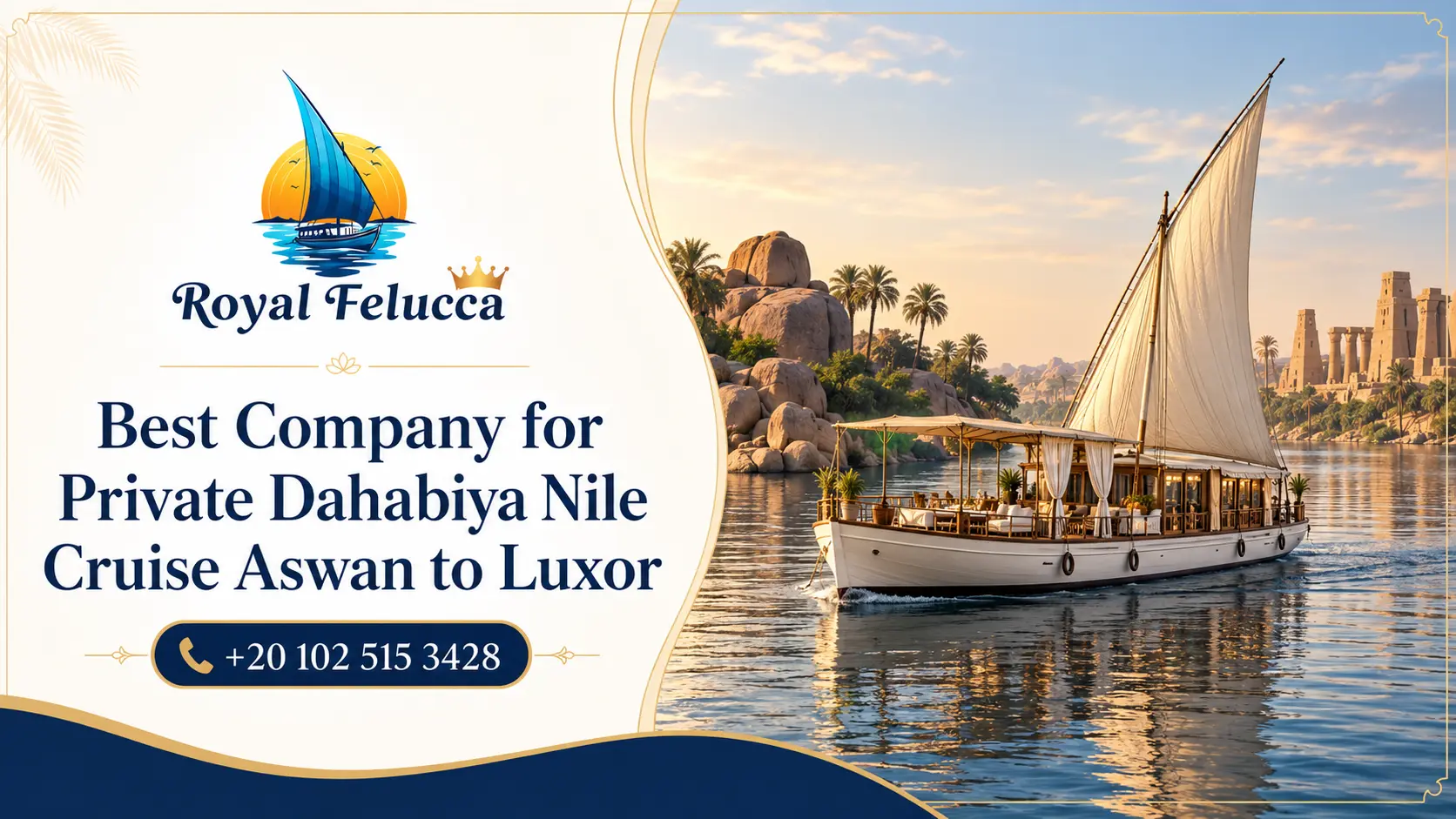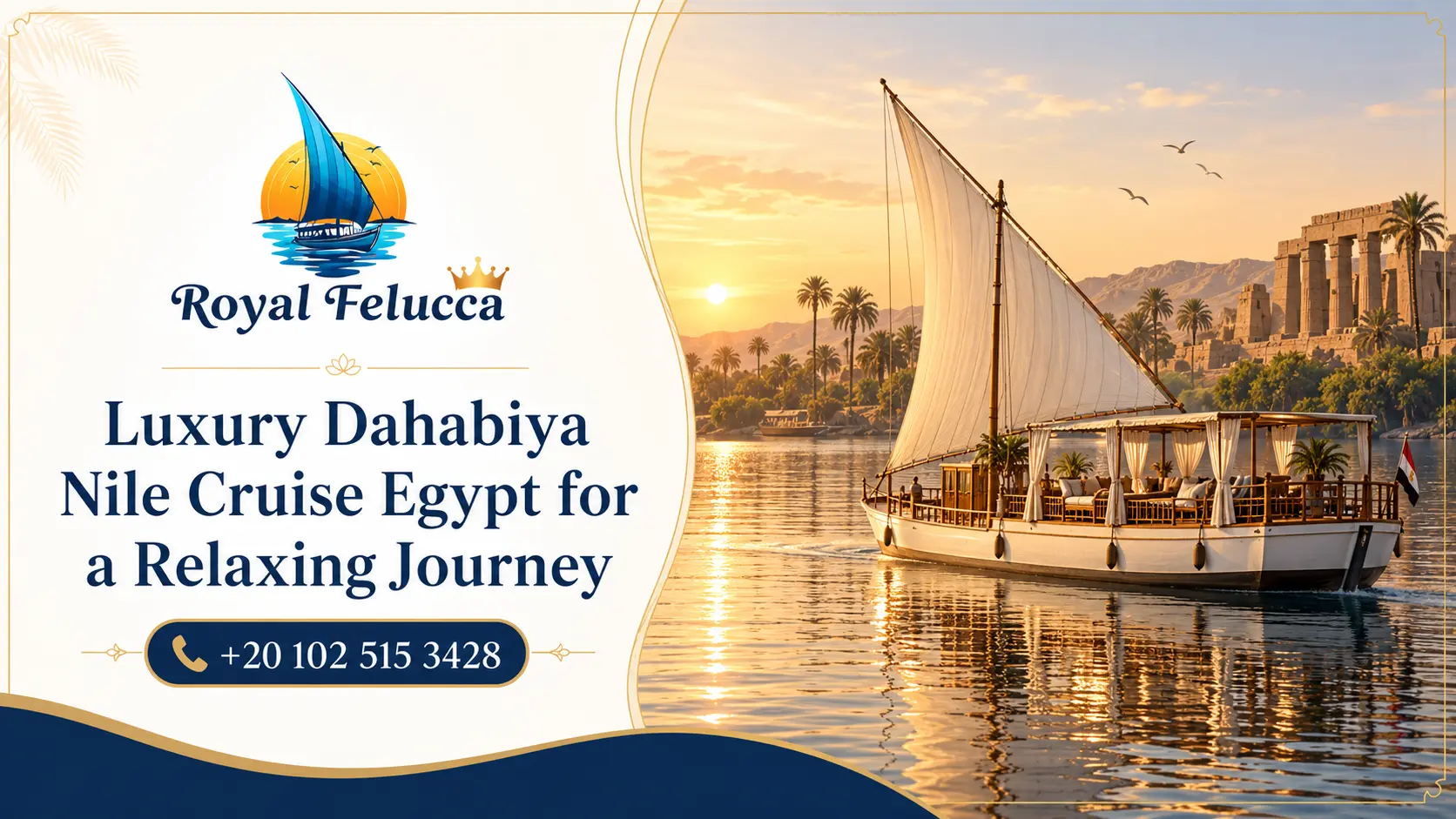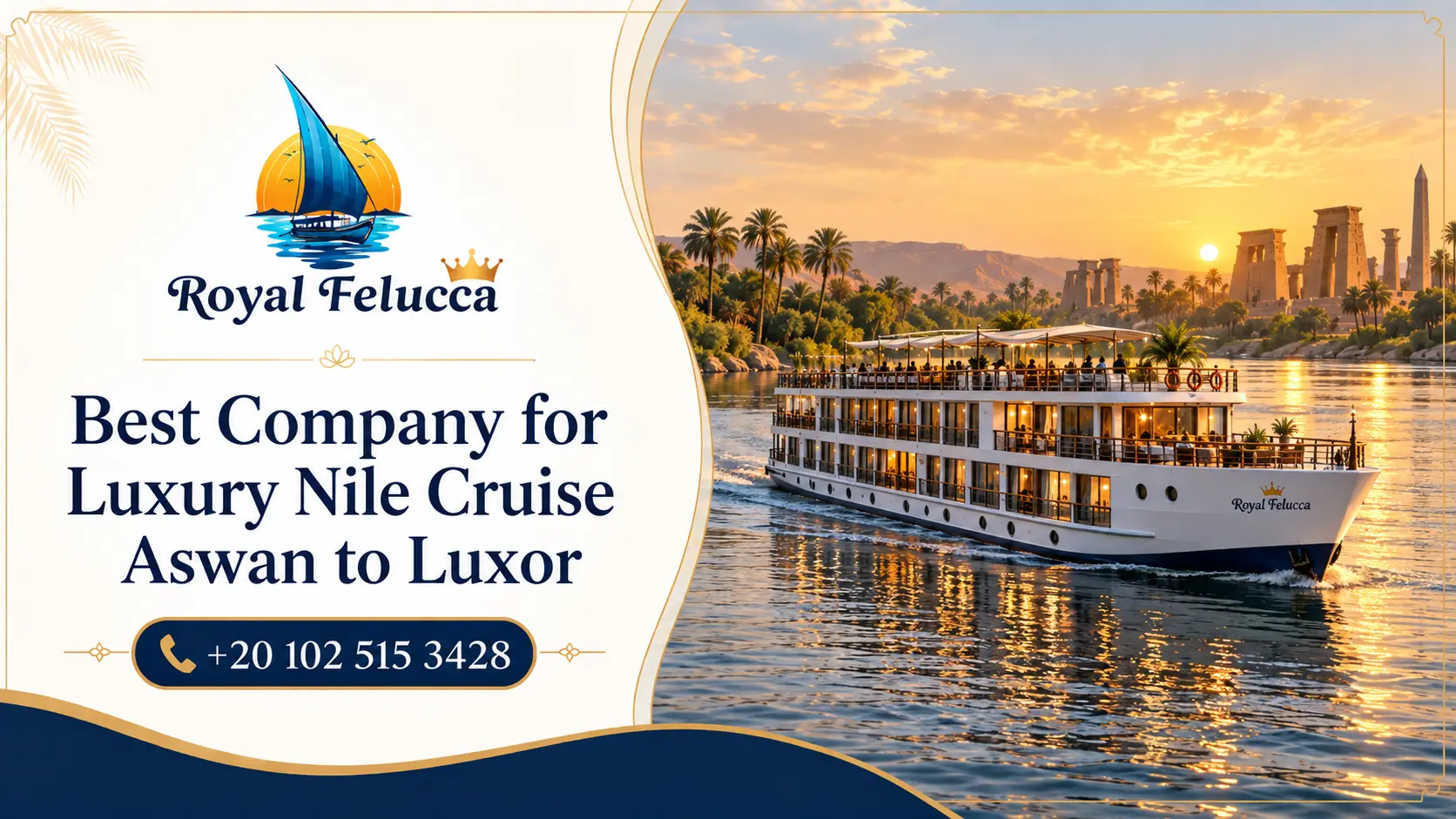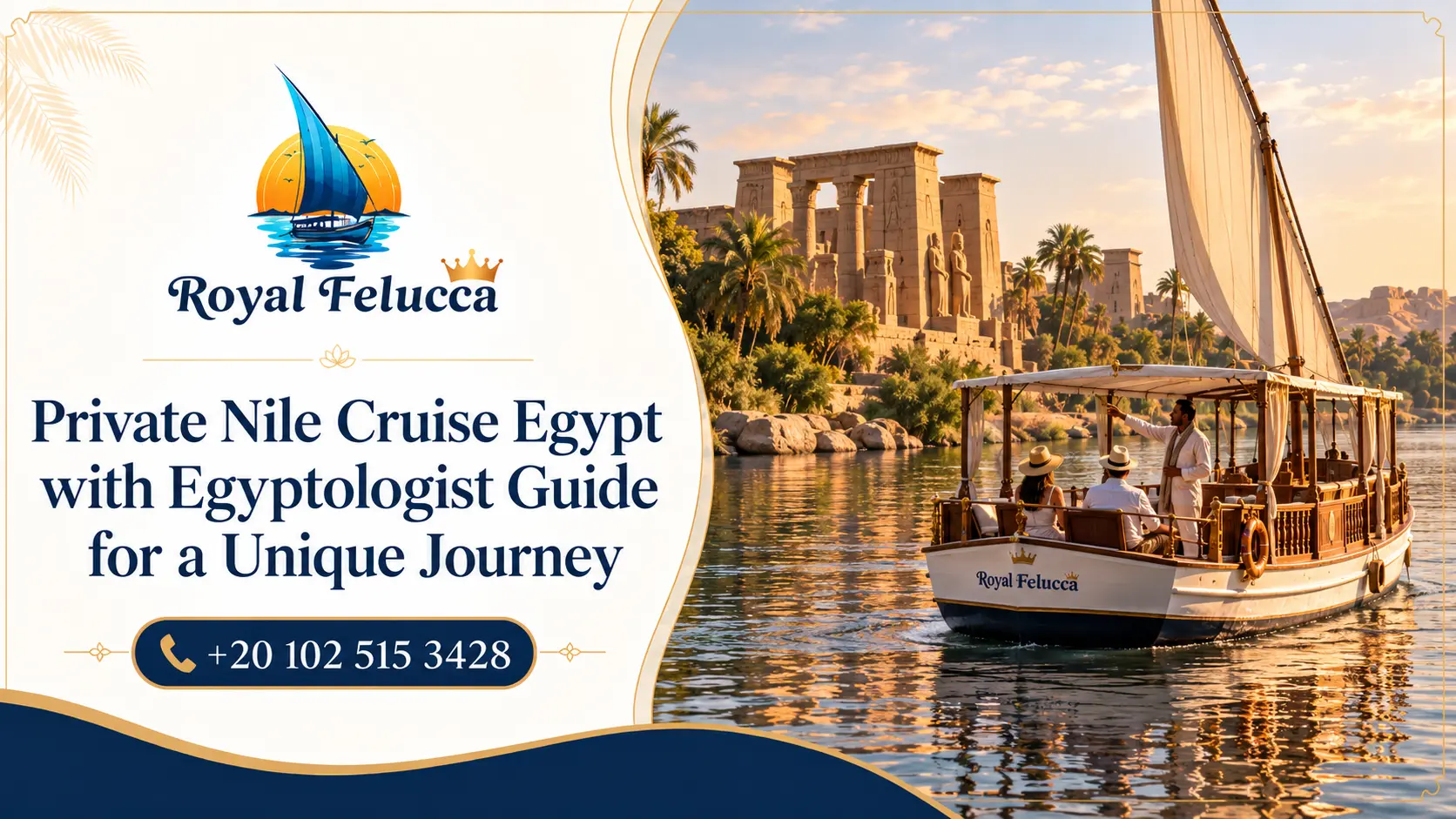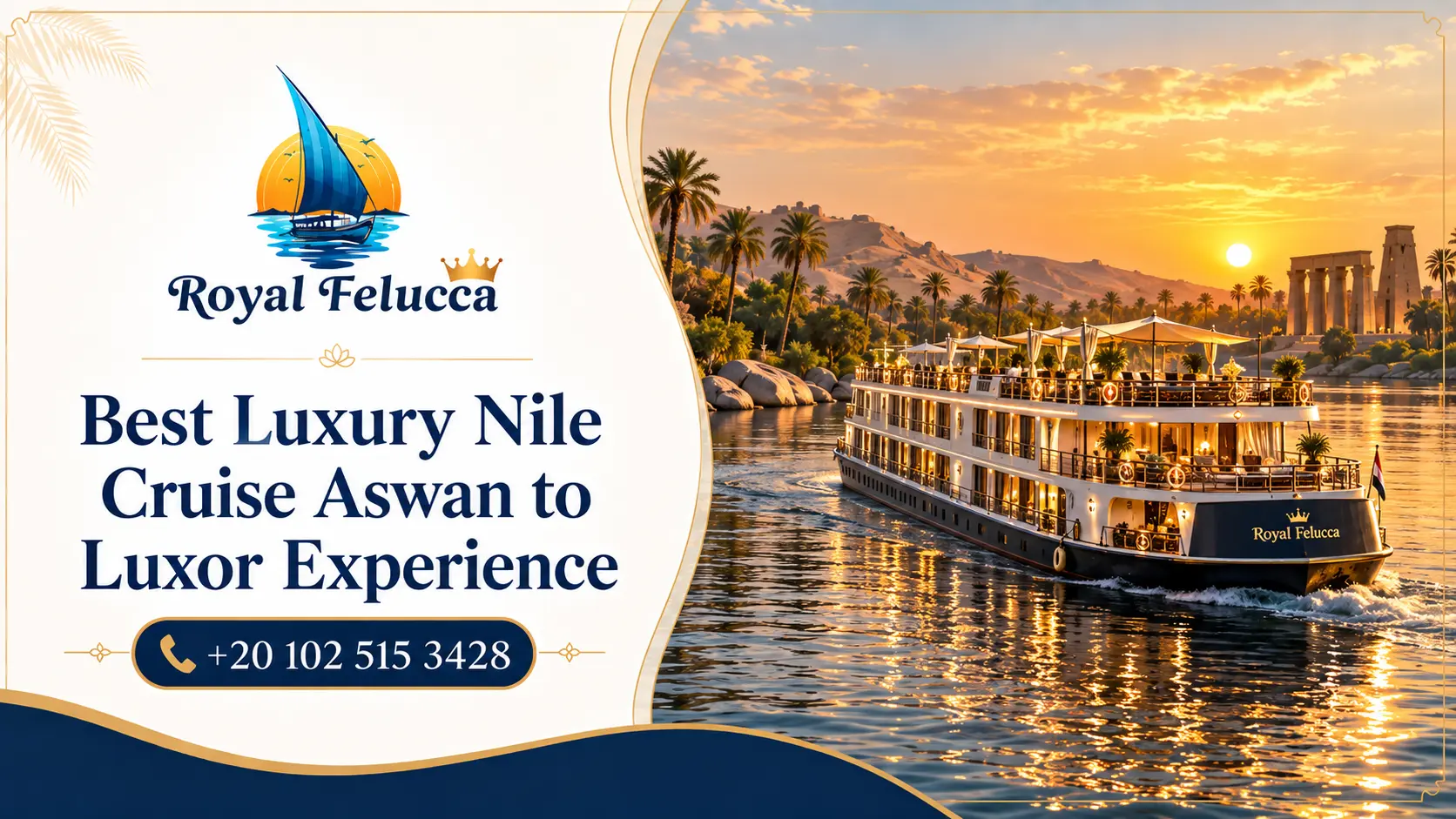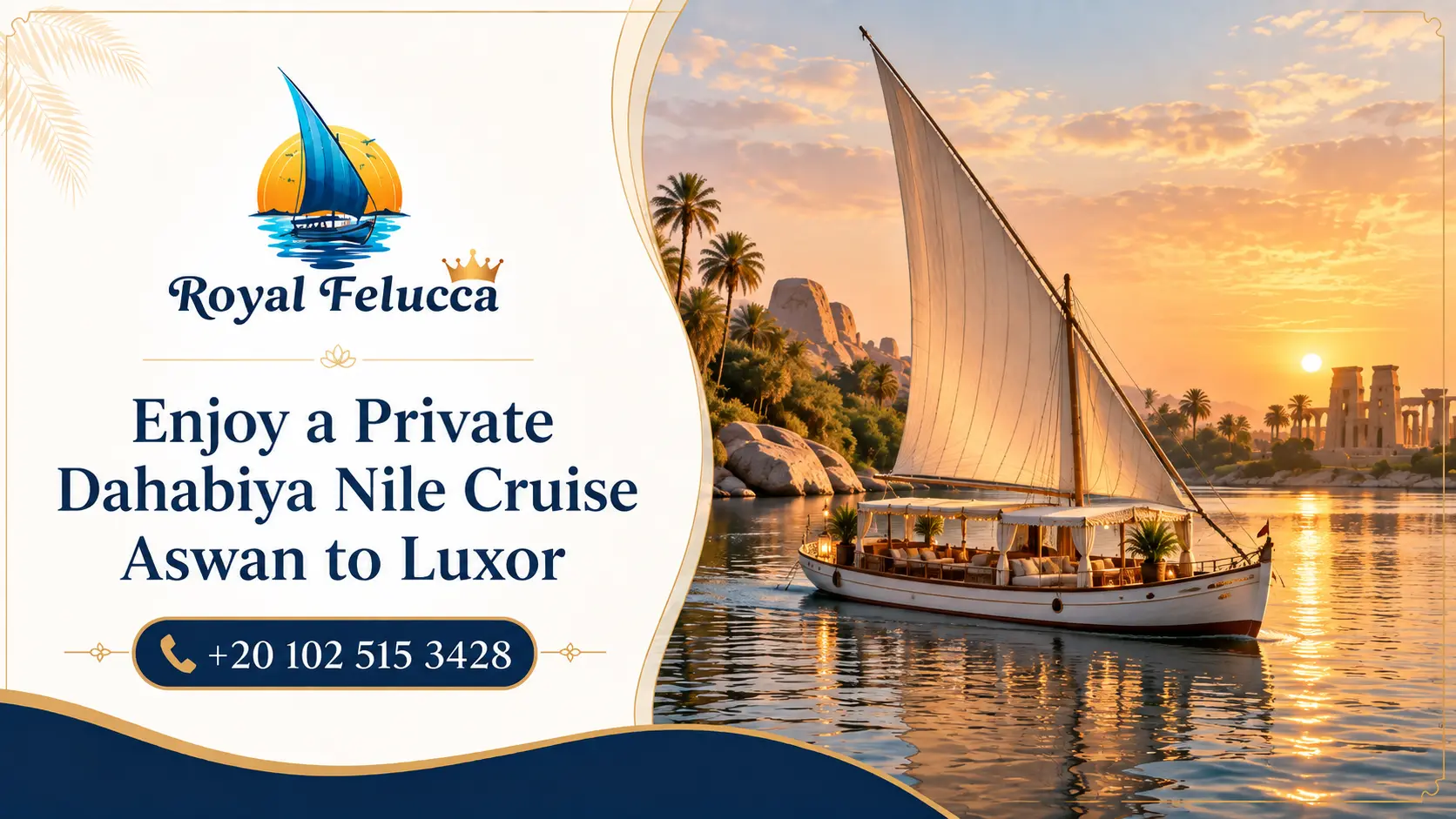
Enjoy a Private Dahabiya Nile Cruise Aswan to Luxor
A journey along the Nile can be one of the most memorable ways to experience Egypt, especially when the river is given enough time to become part of the adventure itself. A private Dahabiya Nile cruise Aswan to Luxor offers travelers a quieter, more intimate alternative to large commercial cruise ships, combining ancient history, beautiful river landscapes, refined accommodation, expert guidance, and authentic Egyptian hospitality.
Instead of rushing between Aswan and Luxor by road, travelers can experience the landscapes that connect them.
Palm-lined riverbanks.
Traditional villages.
Agricultural fields.
Fishing boats.
Birdlife.
Small communities.
Desert horizons.
Ancient temples.
And long stretches of peaceful Nile scenery.
Royal Felucca creates carefully designed journeys for travelers who want to discover Upper Egypt with greater privacy and a more relaxed rhythm. With more than 14 years of sailing experience and over 2,400 guests welcomed, Royal Felucca combines local knowledge, personalized service, premium comfort, curated itineraries, and expert Egyptologist guidance.
Its Dahabiya accommodates only twelve guests across six suites, creating an intimate environment that allows travelers to experience the Nile without the crowds and fixed routines of a large cruise vessel.
For travelers who want comfort, history, privacy, and enough time to appreciate the river itself, a private or intimate Dahabiya journey can provide a distinctive way to travel from Aswan toward Luxor.
About the Private Dahabiya Nile Cruise Aswan to Luxor Experience
A Dahabiya is a smaller Nile vessel designed around a more intimate style of travel.
The atmosphere differs considerably from that of a large commercial ship.
There are fewer guests.
Shared spaces feel calmer.
Meals become more personal.
The crew can provide more attentive service.
Historical visits can feel less crowded.
And travelers have more time to enjoy the river between destinations.
A journey from Aswan toward Luxor can connect some of Upper Egypt’s most remarkable historical and cultural destinations, including the landscapes around Aswan, Kom Ombo, Edfu, and Luxor.
The route is not only important because of the monuments.
The spaces between the monuments are part of the experience.
A private Dahabiya allows travelers to see the Nile Valley unfold gradually rather than disappearing through a car window.
Why Choose a Private Dahabiya From Aswan to Luxor?
The main reason many travelers choose a Dahabiya is the balance it creates.
You can enjoy the comfort of private accommodation while remaining closely connected to the river.
You can explore major historical sites without spending every hour inside a large tour group.
You can enjoy meals onboard without leaving the atmosphere of the Nile.
You can spend afternoons on the sundeck.
Watch sunset.
Talk with your guide.
Relax after temple visits.
The journey becomes less about maximizing the number of stops and more about experiencing each part of Upper Egypt properly.
Begin the Journey in Aswan
Aswan provides a beautiful setting for the beginning of a Nile journey.
The river here flows between islands and granite formations.
Traditional feluccas move across the water.
Palm trees line the shores.
Nubian communities add cultural depth.
The desert appears close behind the fertile riverbanks.
Aswan feels naturally connected to the Nile.
The city’s atmosphere is calmer than many of Egypt’s larger urban centers, making it an ideal place to begin a slower journey northward.
Experience Aswan From the River
The view of Aswan changes completely from the water.
The city appears between islands, boats, palms, and rock formations.
Traditional sails move across the river.
Small communities become more visible.
The relationship between the Nile and the surrounding landscape becomes easier to understand.
This perspective is one of the great strengths of beginning a Dahabiya journey in Aswan.
You do not simply leave the city.
You begin by experiencing it from the environment that defines it.
Discover Elephantine Island
Elephantine Island is one of the most recognizable features of the Aswan landscape.
Its position within the Nile creates beautiful views from a small vessel.
Palm trees.
Traditional buildings.
River channels.
Smaller boats.
The city beyond.
The island also has a long historical connection with southern Egypt.
Experiencing it from the water helps travelers understand why this part of the Nile has been important for so many generations.
Explore the Cultural Character of Nubia
A journey through southern Egypt should include more than ancient temples.
Nubian culture is an essential part of the identity of the Aswan region.
Nubian communities are known for distinctive traditions, architecture, hospitality, and a close relationship with the Nile.
Colorful homes can appear beside the river.
Palm-covered shores frame local communities.
Traditional boats connect different areas.
Depending on the selected journey, travelers may have opportunities to experience Nubian culture more closely.
These encounters create valuable balance.
Ancient monuments reveal Egypt’s historical past.
Nubian communities reveal living culture along the Nile today.
Visit Philae
Philae is one of the most atmospheric archaeological sites around Aswan.
Associated with the goddess Isis, the temple complex contains elegant columns, courtyards, inscriptions, and architectural details.
Its waterside setting creates a particularly memorable experience.
Visiting Philae during a Nile journey reinforces the connection between ancient Egyptian religion and the river.
The temple does not feel separate from the landscape.
Water surrounds it.
The Nile remains part of the experience.
Return to the Peace of the Dahabiya
One of the great pleasures of a Dahabiya journey is the contrast between historical exploration and river relaxation.
A temple visit may be filled with inscriptions, architecture, mythology, and complex history.
Returning to the vessel changes the rhythm immediately.
You can have lunch.
Sit on the sundeck.
Enjoy tea.
Review photographs.
Ask your Egyptologist additional questions.
Or simply watch the water.
This contrast helps prevent the journey from becoming exhausting.
Travel in a Six-Suite Dahabiya
Royal Felucca’s Dahabiya accommodates only twelve guests across six suites.
This limited capacity creates a much more intimate environment than large commercial cruise vessels.
The shared spaces feel quieter.
There is more room on deck.
Meals feel more personal.
The crew has more opportunity to provide attentive service.
For travelers who value privacy and atmosphere, smaller guest numbers can become one of the most important forms of luxury.
Stay in a Refined Suite
Accommodation plays an important role in a multi-day Nile journey.
Royal Felucca’s suites combine traditional wooden character with refined details.
Arched windows connect the interior visually with the river.
Cane headboards introduce natural texture.
Hand-woven textiles add character.
Quality linens support comfortable rest.
Thoughtfully selected amenities complete the environment.
The design is intended to feel elegant without losing the distinctive character of Nile travel.
Enjoy Premium Comfort Without Losing Authenticity
Luxury on the Nile does not need to mean creating a floating version of a large hotel.
A smaller Dahabiya can provide premium comfort while remaining connected to Egypt.
Traditional design.
Natural materials.
Local textures.
River views.
Egyptian hospitality.
Historical guidance.
Nubian culture.
Ancient temples.
These elements allow travelers to enjoy comfort without feeling separated from the destination.
Spend Time on the Sundeck
The sundeck can become one of the most important parts of the journey.
From here, the Nile Valley unfolds gradually.
Fields appear beside the river.
Palm trees frame villages.
Fishing boats move nearby.
Birds cross the water.
The desert remains visible beyond the fertile strip.
A carefully designed itinerary leaves enough time to enjoy these views.
Not every hour needs to be filled with sightseeing.
Some of the strongest memories can come from simply watching Egypt move past.
Enjoy Tea While the Nile Passes By
A simple cup of tea can feel completely different when enjoyed on the Nile.
The background changes constantly.
A village may appear.
A farmer may be working near the riverbank.
Traditional boats may pass nearby.
The wind may begin to cool as the afternoon continues.
These quiet moments are part of what makes a Dahabiya journey feel slower and more personal.
Sail Toward Kom Ombo
As the journey moves away from Aswan, the urban environment gradually gives way to rural Upper Egypt.
Agricultural fields stretch beside the water.
Small communities appear between palm trees.
Traditional river activity continues.
The desert remains close beyond the cultivated land.
This transition is one of the most rewarding parts of traveling by Nile.
The route between destinations becomes meaningful rather than simply being travel time.
Discover the Temple of Kom Ombo
Kom Ombo provides one of the most distinctive temple experiences along the Nile.
Its location beside the river immediately gives it a strong sense of place.
The temple is particularly known for its association with both Sobek and Horus.
Its double character makes the site unique among many other ancient Egyptian temples.
Arriving within the context of a Nile journey helps travelers appreciate the relationship between the temple and the river.
The Nile supported settlement, agriculture, transport, and religious life.
At Kom Ombo, that connection feels especially clear.
Experience Kom Ombo With an Egyptologist Guide
An Egyptologist can transform a temple visit.
Instead of simply admiring stone walls and carvings, travelers can understand the gods represented at the site.
The symbolism.
The architecture.
The historical context.
The inscriptions.
The purpose of different spaces.
Royal Felucca journeys can include Egyptologist guidance, helping guests gain a deeper understanding of ancient Egypt throughout the itinerary.
Watch Kom Ombo Change in the Light
The atmosphere around Kom Ombo can be especially beautiful when the light begins to soften.
Ancient stone takes on warmer tones.
Shadows become longer.
The river remains visible nearby.
For photography, these conditions can be particularly attractive.
A relaxed Dahabiya journey allows enough time to experience the site as a place rather than only as an item on a sightseeing checklist.
Continue Through the Nile Valley
After Kom Ombo, the journey continues through the agricultural heart of Upper Egypt.
The Nile supports a narrow strip of fertile land surrounded by desert.
This geography becomes impossible to ignore from the river.
Fields.
Palms.
Villages.
Animals.
Boats.
Birds.
Daily life.
The landscape explains why the Nile has always been so important.
It is not merely a beautiful waterway.
It is the foundation around which communities have developed for thousands of years.
Discover Everyday Life Along the Nile
One of the advantages of moving slowly is seeing ordinary life.
Not every scene needs to be a famous attraction.
A fisherman on the water.
A farmer beside a field.
Children near a village.
Traditional boats crossing the Nile.
Birds resting near the riverbank.
These moments reveal a side of Egypt that many fast itineraries miss.
They create a stronger sense of place and continuity.
Arrive Near Edfu
Edfu introduces another major historical chapter.
The Temple of Horus is one of the most impressive ancient temples in Egypt.
Its state of preservation allows visitors to understand the structure and atmosphere of an ancient temple in remarkable detail.
The monumental entrance immediately creates a sense of scale.
Inside, courtyards, columns, chambers, carvings, and inscriptions reveal a complex religious environment.
Explore the Temple of Horus
The Temple of Horus provides travelers with an opportunity to experience one of the best-preserved temple complexes in the country.
An Egyptologist can explain the mythology associated with Horus.
The role of different parts of the temple.
The stories represented in the reliefs.
The relationship between religion and royal authority.
With this context, the temple becomes far more than an impressive ancient building.
Learn the Story Behind the Architecture
Ancient temples were designed carefully.
Different spaces served different functions.
Ceremonial routes mattered.
Symbolism mattered.
Inscriptions communicated religious and political ideas.
An expert guide helps travelers understand these details.
This is one of the strongest advantages of including an Egyptologist within a private Nile journey.
The historical sites begin to connect into one continuous story.
Return to the River After Edfu
After the scale and complexity of Edfu, returning to the Dahabiya creates another welcome change of pace.
The journey becomes quiet again.
The Nile continues.
Lunch can be served.
The sundeck becomes a place to rest.
The temple experience has time to settle.
This balance allows travelers to appreciate history without becoming overwhelmed by it.
Full-Board Dining Adds Ease to the Experience
Royal Felucca’s Dahabiya Experience can include full-board dining.
This simplifies the journey and helps meals remain part of the river experience.
Breakfast can begin with views of the Nile.
Lunch can be served while sailing.
Dinner can take place beneath the evening sky.
Travelers do not need to organize meals independently every day.
Instead, dining becomes another element of the journey.
Meals Feel More Personal on a Small Vessel
Dining aboard a smaller vessel feels very different from eating in a large cruise-ship restaurant.
There are fewer guests.
The atmosphere is calmer.
Conversations feel easier.
The river remains close.
The landscape becomes part of the setting.
For travelers who value intimate experiences, this can be far more appealing than large-scale dining environments.
Watch Sunset From the Nile
Sunset can become one of the most memorable daily rituals of the journey.
The afternoon light softens.
The Nile reflects changing colors.
Palm trees become silhouettes.
Villages begin to quiet.
The temperature may become more comfortable.
From the sundeck, travelers can simply remain where they are and watch the scene develop.
There is no need to search for a viewpoint.
The entire Nile becomes the viewpoint.
Enjoy Dinner Beneath the Stars
Evening creates another atmosphere.
The river grows quieter.
The sky becomes more prominent.
The energy of the day slows.
Dinner beneath the stars can become one of the most elegant and peaceful moments of a Dahabiya journey.
There is time to talk.
Time to reflect on the day.
Time to ask questions.
Time simply to enjoy being on the Nile.
Wake Up to Another Nile Landscape
One of the advantages of cruising is the ability to move while remaining settled in the same accommodation.
You go to sleep in your suite.
You wake to a different view.
Your luggage stays unpacked.
You do not need to change hotels.
You do not need to spend hours checking in and out.
This continuity creates a much more relaxed multi-destination journey through Upper Egypt.
Approach Luxor Gradually
As the journey continues toward Luxor, the historical significance of the Nile becomes increasingly powerful.
By this stage, travelers have experienced temples, river landscapes, villages, agricultural land, and the geography connecting them.
Luxor therefore does not appear as an isolated destination.
It becomes part of a continuous historical landscape shaped by the Nile.
Discover Luxor
Luxor contains some of Egypt’s most remarkable archaeological treasures.
The region is home to monumental temple complexes, royal tombs, statues, inscriptions, and ancient landscapes associated with some of Egypt’s most powerful rulers.
Arriving after a journey along the Nile can deepen the experience.
Travelers understand the river context surrounding the monuments.
The geography starts to make sense.
The relationship between the east and west banks becomes more meaningful.
Explore Karnak
Karnak is one of the great archaeological highlights of Egypt.
The site developed over centuries.
Massive columns rise above visitors.
Monumental gateways connect different areas.
Courtyards, obelisks, statues, inscriptions, and ceremonial spaces reveal the scale and importance of the complex.
With an Egyptologist guide, travelers can understand how different rulers contributed to Karnak and how the site functioned within ancient Egyptian religious life.
Experience the Valley of the Kings
Across the Nile, the Valley of the Kings offers a completely different experience.
The desert landscape contains royal tombs carved into the rock.
Inside, corridors and burial chambers are decorated with scenes connected to death, rebirth, kingship, and the afterlife.
The contrast between the bright desert outside and the decorated interiors can be striking.
Expert historical guidance helps travelers understand the symbolism rather than simply admiring the decoration.
Connect Luxor With Everything You Have Already Seen
One of the advantages of traveling with an Egyptologist throughout a wider Nile journey is continuity.
The guide can connect ideas introduced earlier.
The gods.
The rulers.
The temple architecture.
The religious symbolism.
The relationship between the Nile and ancient settlements.
By the time you reach Luxor, the historical story feels connected rather than fragmented.
Why Privacy Makes the Journey More Enjoyable
Privacy changes the way travelers experience the river.
A smaller guest count means fewer distractions.
There is more space on deck.
Meals feel quieter.
Conversations with the guide can become more detailed.
The atmosphere after excursions is calmer.
For couples, families, and small groups, this can make the journey feel much more personal.
A Private Dahabiya Is Ideal for Couples
Couples often appreciate the naturally romantic atmosphere of a smaller Nile vessel.
Private suites provide personal space.
The sundeck offers quiet views.
Sunset can be enjoyed together.
Meals become intimate.
Dinner beneath the stars creates another memorable setting.
For honeymoons, anniversaries, or special journeys, a Dahabiya can combine history and romance without becoming overly formal.
A Dahabiya Can Be Excellent for Families
Families can also benefit from this style of travel.
Instead of moving through several hotels, the family remains settled onboard.
Children can experience temples, hieroglyphs, traditional boats, villages, agricultural landscapes, and wildlife within one connected journey.
Sailing time provides a natural break between historical visits.
The smaller environment can also feel calmer for parents than a large cruise ship.
A Private Dahabiya Works Well for Small Groups
Friends and extended families may also appreciate the intimacy of a Dahabiya.
Meals become shared experiences.
The sundeck becomes a natural gathering place.
Historical discoveries can be enjoyed together.
The limited number of guests means the journey retains a more personal atmosphere.
For celebrations or private group travel, this can be especially valuable.
Photography Lovers Can Enjoy the Slower Rhythm
The route through Upper Egypt provides a wide range of photography opportunities.
Traditional sails.
Palm trees.
Villages.
Birdlife.
Agricultural fields.
Desert horizons.
Ancient temples.
River reflections.
Morning light.
Sunset.
A slower journey gives travelers more time to observe these scenes.
Photography becomes part of the rhythm rather than something done hurriedly through a vehicle window.
Morning on the Nile Has Its Own Atmosphere
Morning can be one of the most peaceful times during the journey.
The light is softer.
The air may feel cooler.
Birds become more noticeable.
The river can appear calm.
Villages gradually begin another day.
Waking aboard the Dahabiya allows travelers to experience this naturally.
There is no need to organize a separate excursion.
The scenery is already outside the suite.
Personalized Service Adds Value
Every traveler wants something different from Egypt.
Some guests care most about ancient history.
Some are interested in photography.
Others want relaxation.
Some want more cultural experiences.
Some are celebrating a special occasion.
Royal Felucca focuses on personalized service so the overall journey can reflect the rhythm and interests of the guests.
A small vessel makes this type of attention easier to provide.
Authentic Egyptian Hospitality Matters
Hospitality can become one of the most memorable parts of a journey.
Royal Felucca focuses on warm, genuine, and unhurried Egyptian hospitality.
The goal is attentive service without creating an overly formal atmosphere.
Travelers spend multiple days with the team, guide, and crew.
That continuity can make the journey feel more personal and connected.
Luxury Is Also About Time
Luxury is often measured by facilities, but time can be even more valuable.
Time to explore a temple properly.
Time to ask an Egyptologist questions.
Time to enjoy lunch.
Time to watch sunset.
Time to rest after an excursion.
Time to notice villages along the Nile.
A carefully designed Dahabiya journey protects this space.
It does not need to fill every minute with activities.
Avoid Turning the Journey Into a Checklist
Egypt has enough archaeological sites to fill several trips.
Trying to visit too many places too quickly can reduce the quality of the experience.
A stronger itinerary focuses on meaningful discovery.
Important temples can be explored properly.
Historical context can be explained.
The Nile can still be enjoyed.
The result feels like a journey rather than a race.
Convenience Is Part of a Premium Nile Experience
A high-quality private journey should reduce unnecessary travel stress.
Royal Felucca’s Dahabiya Experience can include full-board dining, domestic flights, an Egyptologist guide, temple entrances, airport transfers, and in-suite amenities depending on the selected itinerary.
When these elements are coordinated, travelers spend less time managing logistics.
They can focus more fully on the places and experiences around them.
Understand What Is Included Before Booking
Travelers should always compare the complete experience.
Consider the number of guests.
The accommodation.
The itinerary.
The guiding.
The meals.
Temple entrance arrangements.
Transfers.
Domestic flights when relevant.
Time allocated for relaxation.
Clear inclusions make it easier to understand the real value of a Dahabiya journey.
Dahabiya vs Large Nile Cruise
A large Nile cruise and a Dahabiya can both provide access to Upper Egypt’s major historical destinations, but the atmosphere differs considerably.
Large ships carry more guests.
A Dahabiya carries fewer.
Large vessels may offer more extensive facilities.
A Dahabiya emphasizes privacy and atmosphere.
Large cruises often follow standardized schedules.
Smaller journeys can feel more personal.
Travelers who value quieter shared spaces, historical depth, personal service, and time on the river may find a Dahabiya particularly attractive.
Dahabiya vs Traditional Felucca
Royal Felucca also offers a traditional private felucca experience.
The felucca provides a simpler style of river travel.
Wind-powered sailing.
Open-deck living.
Fresh onboard meals.
Nubian shores.
A direct relationship with the river.
The Dahabiya offers a higher level of accommodation through private suites and refined amenities.
Travelers seeking simplicity and traditional outdoor sailing may prefer the felucca.
Those seeking intimate Nile travel with greater comfort may prefer the Dahabiya.
The Best Time for a Dahabiya Journey
October through April generally provides some of the most comfortable conditions for exploring Upper Egypt.
Temperatures are better suited to archaeological visits and spending time outside on the sundeck.
Morning light can be attractive for photography.
Afternoons can be comfortable for relaxing.
Evenings can provide pleasant conditions for outdoor dining.
Because a six-suite Dahabiya has limited availability, travelers with fixed dates may benefit from planning in advance.
Why Choose Royal Felucca?
Royal Felucca creates Nile experiences centered on intimacy, comfort, discovery, and authentic Egyptian hospitality.
The team brings more than 14 years of sailing experience and has welcomed over 2,400 guests.
Its Dahabiya carries only twelve guests across six suites, creating a calm alternative to large commercial cruise ships.
The suites combine traditional wooden character with arched windows, cane headboards, hand-woven textiles, quality linens, and thoughtful amenities.
Personalized service helps the journey feel more attentive.
Curated itineraries balance historical exploration with time to enjoy the Nile.
Expert Egyptologist guidance adds depth to temple visits.
Full-board dining can be included.
Temple entrances, airport transfers, domestic flights, and in-suite amenities can also form part of the selected journey.
Authentic Egyptian hospitality remains central throughout the experience.
For travelers seeking traditional simplicity, Royal Felucca also offers private felucca sailing.
Make the Nile the Center of the Experience
The strongest Dahabiya journeys do not treat the Nile as empty space between attractions.
The river should remain present throughout.
It is the view from the suite.
The background to lunch.
The setting for sunset.
The route connecting historical destinations.
The landscape outside the sundeck.
The atmosphere during dinner.
The river is not simply transporting travelers through Upper Egypt.
It is one of the main reasons for taking the journey.
Create Memories Between the Famous Sites
The major temples may naturally become highlights.
But the quieter moments often remain just as memorable.
Tea on the sundeck.
A bird crossing the river.
A fishing boat passing close by.
A village appearing behind palm trees.
A conversation with the Egyptologist.
A long lunch.
Sunset.
Dinner beneath the stars.
Waking to another landscape.
These experiences happen because the journey leaves enough space for them.
Conclusion
A private Dahabiya Nile cruise Aswan to Luxor offers travelers a refined and intimate way to discover Upper Egypt.
The journey can begin among the islands, traditional boats, Nubian culture, and beautiful landscapes of Aswan.
Kom Ombo introduces a remarkable riverside temple associated with Sobek and Horus.
Edfu reveals the extraordinary Temple of Horus.
Luxor brings travelers into a landscape filled with monumental temples, royal tombs, and some of ancient Egypt’s most significant archaeological sites.
But the true strength of the journey lies in everything connecting these destinations.
The Nile.
The villages.
The agricultural landscapes.
The changing light.
The quiet deck time.
The meals.
The expert historical guidance.
The evenings beneath the stars.
Royal Felucca combines more than 14 years of sailing experience, over 2,400 welcomed guests, personalized service, carefully curated itineraries, premium comfort, expert Egyptologist guidance, and authentic Egyptian hospitality.
Its Dahabiya carries only twelve guests across six refined suites, providing a peaceful alternative to large commercial cruise vessels.
For travelers who want to experience Aswan, Kom Ombo, Edfu, Luxor, and the landscapes between them with greater privacy and a more relaxed rhythm, a Dahabiya offers a distinctive way to discover the Nile.
You do not simply travel from Aswan to Luxor.
You enjoy the entire journey between them.
And that is what can make the Nile one of the most memorable parts of your experience in Egypt.