Nile Cruise vs Felucca and Which One Is Better for Your Trip
Choosing how to experience the Nile is one of the most important decisions when planning a journey through Upper Egypt. The river connects extraordinary historical destinations, traditional communities, fertile landscapes, and some of Egypt’s most impressive ancient temples. However, not every Nile journey feels the same.
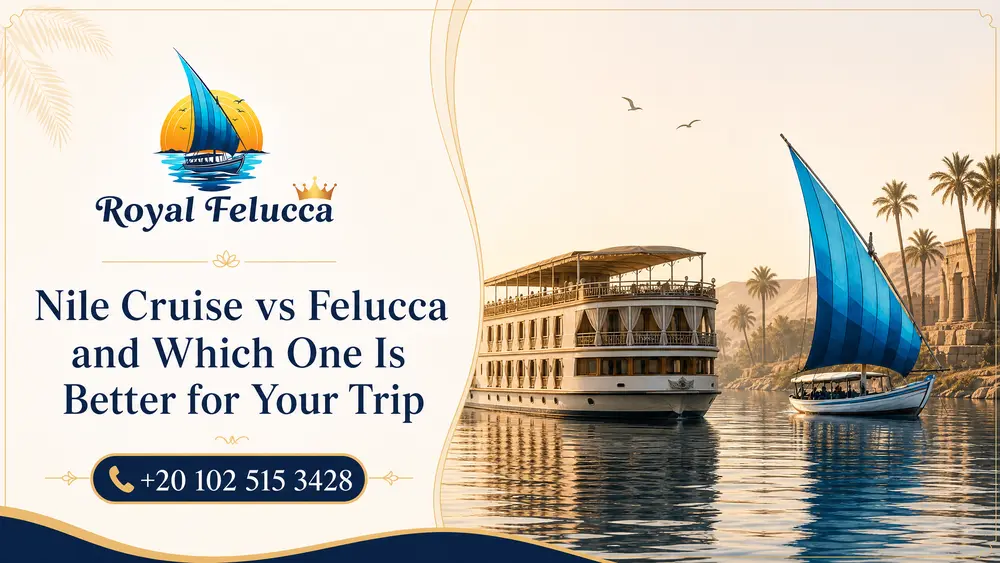
For many travelers, the decision comes down to Nile cruise vs felucca. Should you choose the greater comfort and structured experience of a Nile cruise, or the simplicity, privacy, and traditional character of a felucca?
The right answer depends on the kind of traveler you are, how much time you have, the level of comfort you expect, the destinations you want to visit, and how closely you want to connect with the Nile itself.
Royal Felucca creates carefully designed Nile experiences that offer different ways to discover Upper Egypt. Travelers can enjoy the refined character of a dahabiya or experience the timeless simplicity of traditional felucca sailing. With more than 14 years of sailing experience and over 2,400 guests welcomed, Royal Felucca focuses on personalized service, authentic Egyptian hospitality, scenic sailing, and meaningful discovery.
About the Nile Cruise vs Felucca Experience
Both Nile cruises and feluccas allow travelers to experience Egypt from the river, but they create very different journeys.
A Nile cruise generally focuses on combining sightseeing, accommodation, meals, and transportation between major destinations. Travelers can explore historic locations while returning to comfortable accommodation onboard.
A felucca provides a much more traditional sailing experience. It is smaller, quieter, and closely connected to the natural rhythm of the Nile.
Traditional feluccas depend on the wind rather than an engine, which means the journey is not designed around speed. Instead, travelers have more opportunity to appreciate the river, local villages, agricultural landscapes, Nubian culture, and quiet moments along the water.
The best option depends on whether you prioritize greater comfort and a broader itinerary or simplicity, privacy, and a more direct connection with the Nile.
What Is a Nile Cruise?
A Nile cruise is a river journey that typically combines accommodation, meals, sightseeing, and transportation between historical destinations.
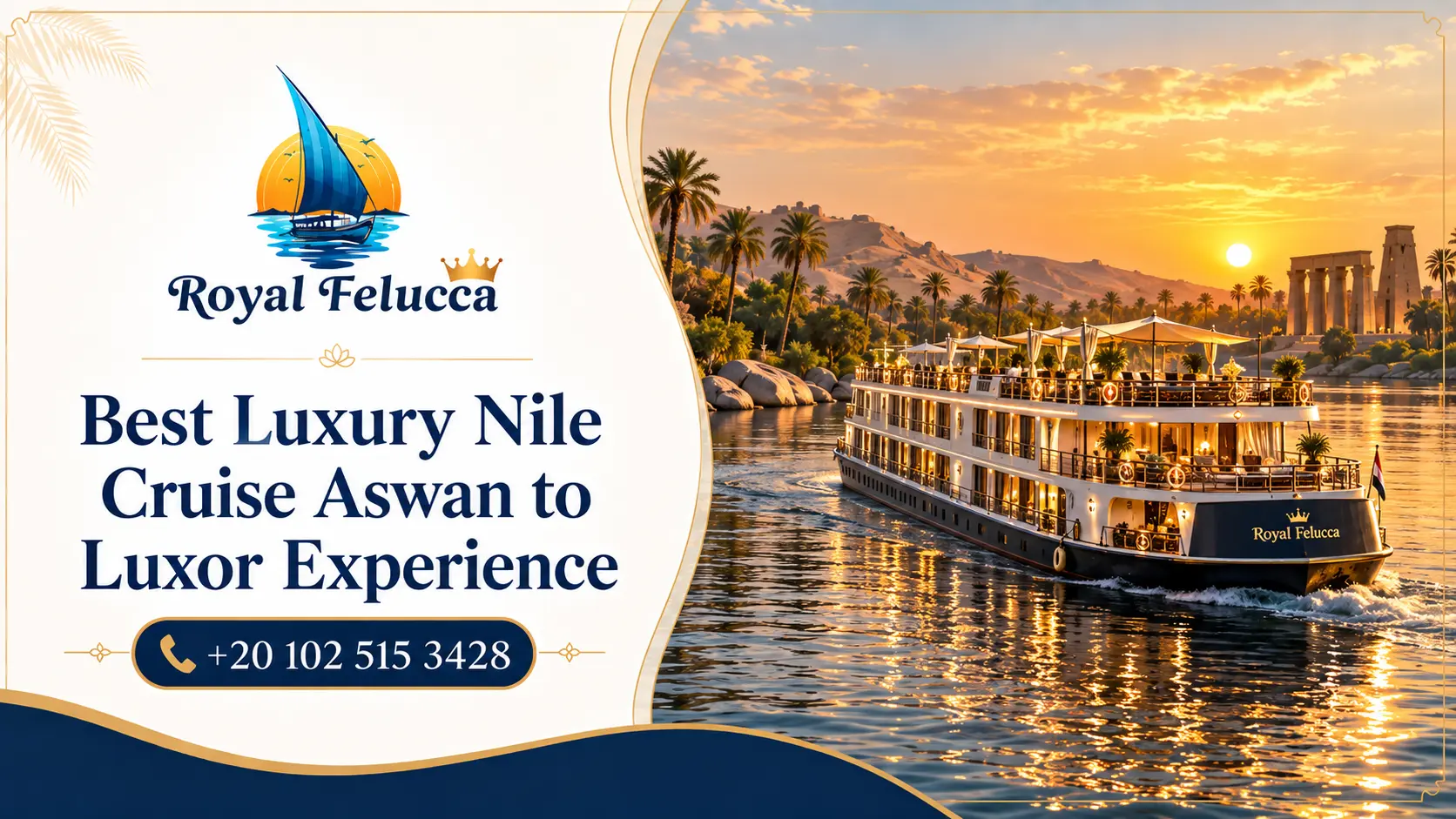
Many Nile cruise itineraries travel through Upper Egypt and connect destinations such as Luxor, Edfu, Kom Ombo, and Aswan.
The main advantage is convenience.
Your accommodation travels with you, reducing the need to change hotels between different destinations.
You can spend your morning visiting an ancient temple, return to the vessel to relax, enjoy a meal, and continue sailing toward the next destination.
For travelers who want to see several important historical sites while maintaining a higher level of comfort, a Nile cruise can be an attractive choice.
What Is a Felucca?
A felucca is a traditional Egyptian sailing boat closely associated with the Nile.
Unlike a conventional motorized cruise vessel, a traditional felucca moves primarily with the wind.
This creates a much quieter experience.
There is no constant engine noise.
There is no need to rush toward every destination.
The focus becomes the river itself.
Travelers can sit on the open deck, enjoy freshly prepared food, watch palm-covered shores pass slowly, see local communities beside the water, and experience sunsets and evenings in a peaceful environment.
Royal Felucca’s traditional experience is private and designed for travelers who want a more authentic connection with the Nile.
Nile Cruise vs Felucca: The Main Difference
The biggest difference between a Nile cruise and a felucca is the style of travel.
A conventional Nile cruise is generally designed around comfort, planned itineraries, and easier movement between several major attractions.
A felucca emphasizes simplicity, privacy, traditional sailing, and a slower connection to the landscape.
One is not automatically better than the other.
They simply appeal to different travelers.
If your priority is seeing multiple historical destinations with comfortable accommodation and organized services, a cruise-style journey may suit you better.
If your priority is slowing down, sailing traditionally, experiencing Nubian shores, and spending more intimate time on the river, a felucca may be the better choice.
Comfort: Nile Cruise or Felucca?
Comfort is one of the clearest differences when comparing Nile cruise vs felucca.
A cruise vessel generally provides cabins or suites, private indoor spaces, and more conventional onboard facilities.
A traditional felucca is much simpler.
Its appeal comes from open-deck living and close contact with the Nile rather than hotel-style accommodation.
This does not mean the felucca experience lacks thoughtful hospitality.
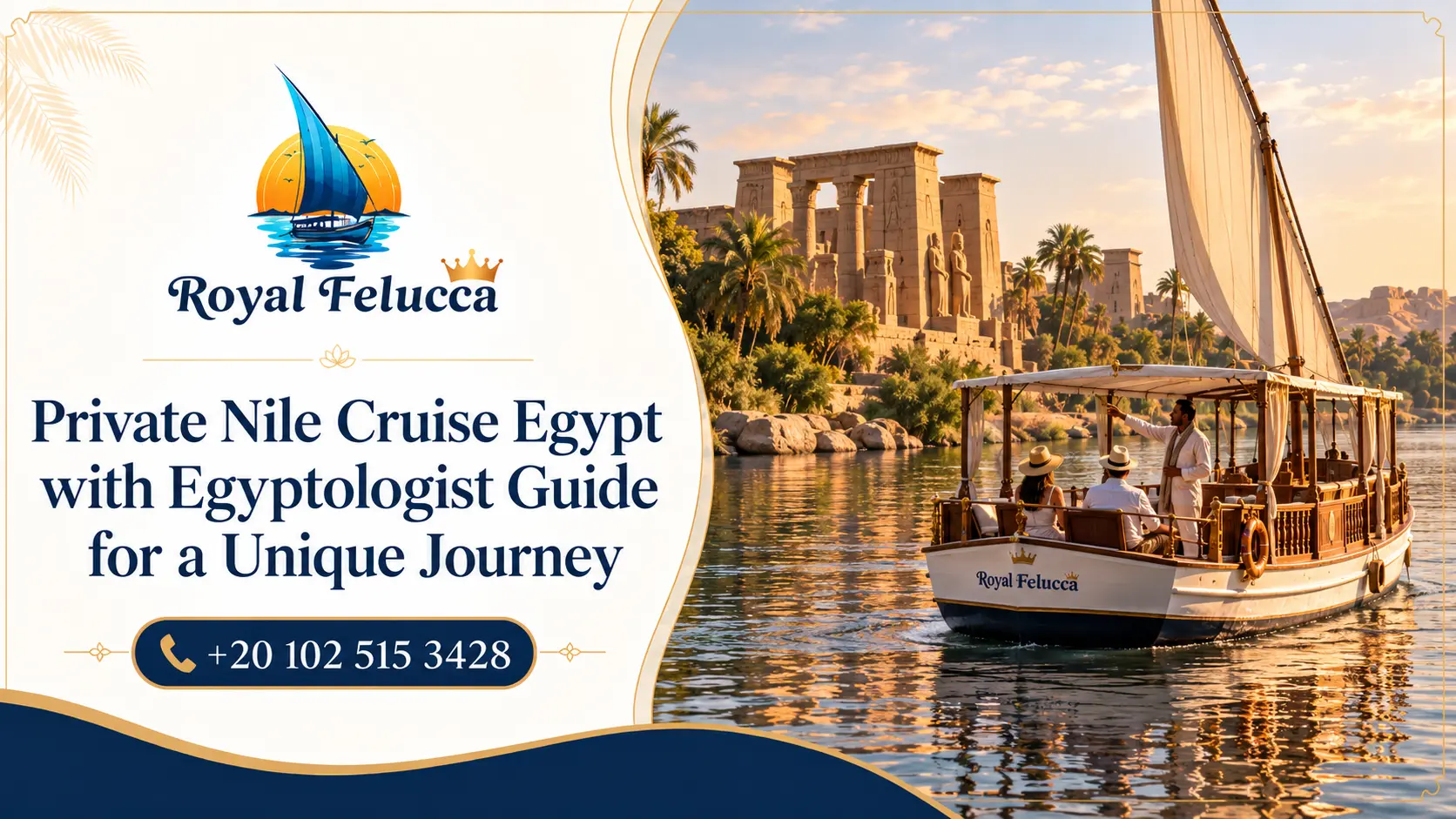
Royal Felucca’s traditional journey can include bedding, linens, freshly prepared onboard meals, transfers, temple entrances, and Egyptologist guidance.
However, travelers should choose the experience understanding that traditional felucca sailing is about simplicity and authenticity.
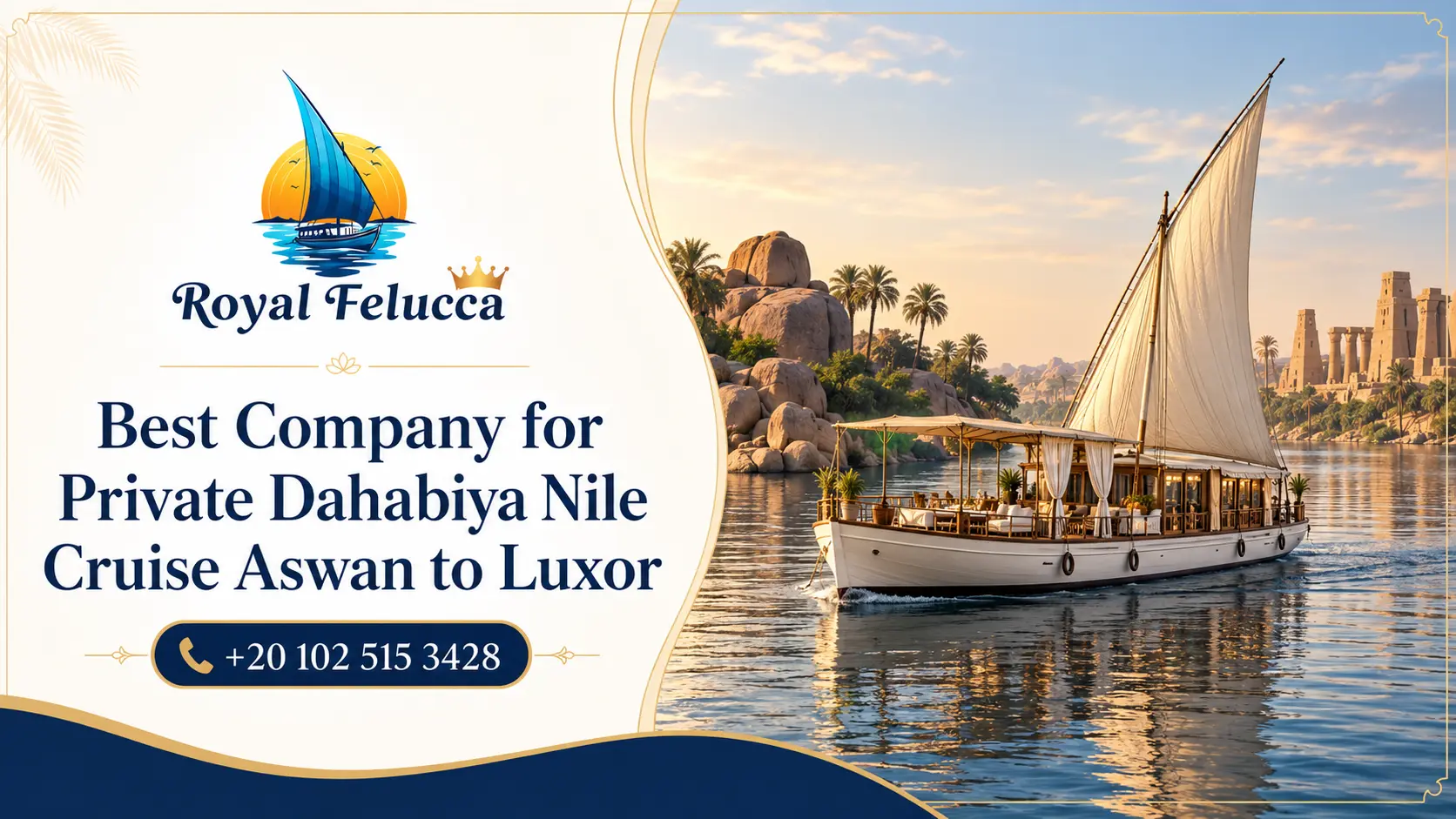
For guests who want more refined accommodation while still avoiding a large commercial cruise ship, a dahabiya offers an excellent middle ground.
The Dahabiya: A Refined Alternative
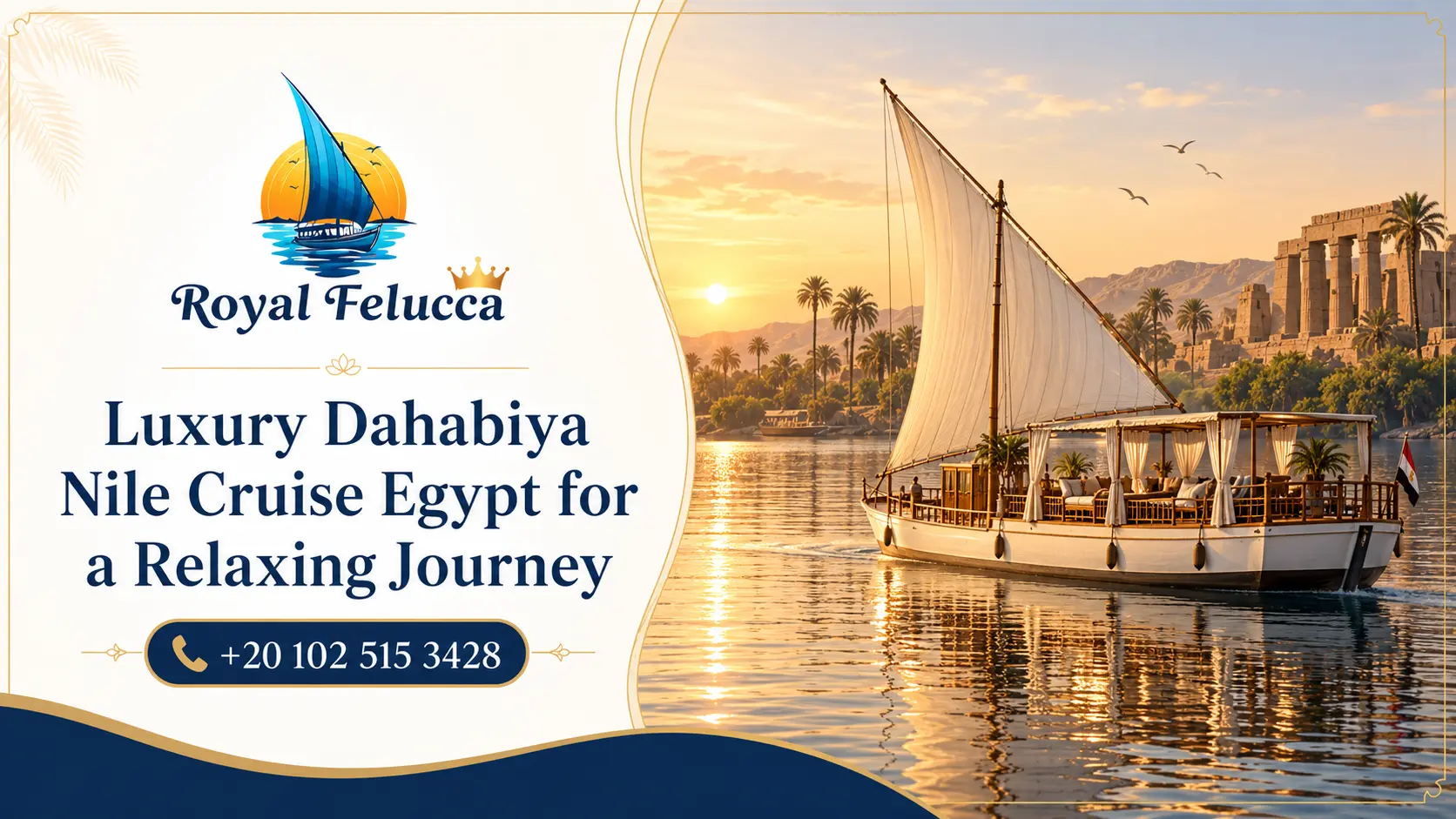
A dahabiya combines many of the advantages travelers appreciate about traditional Nile sailing with a greater level of comfort.
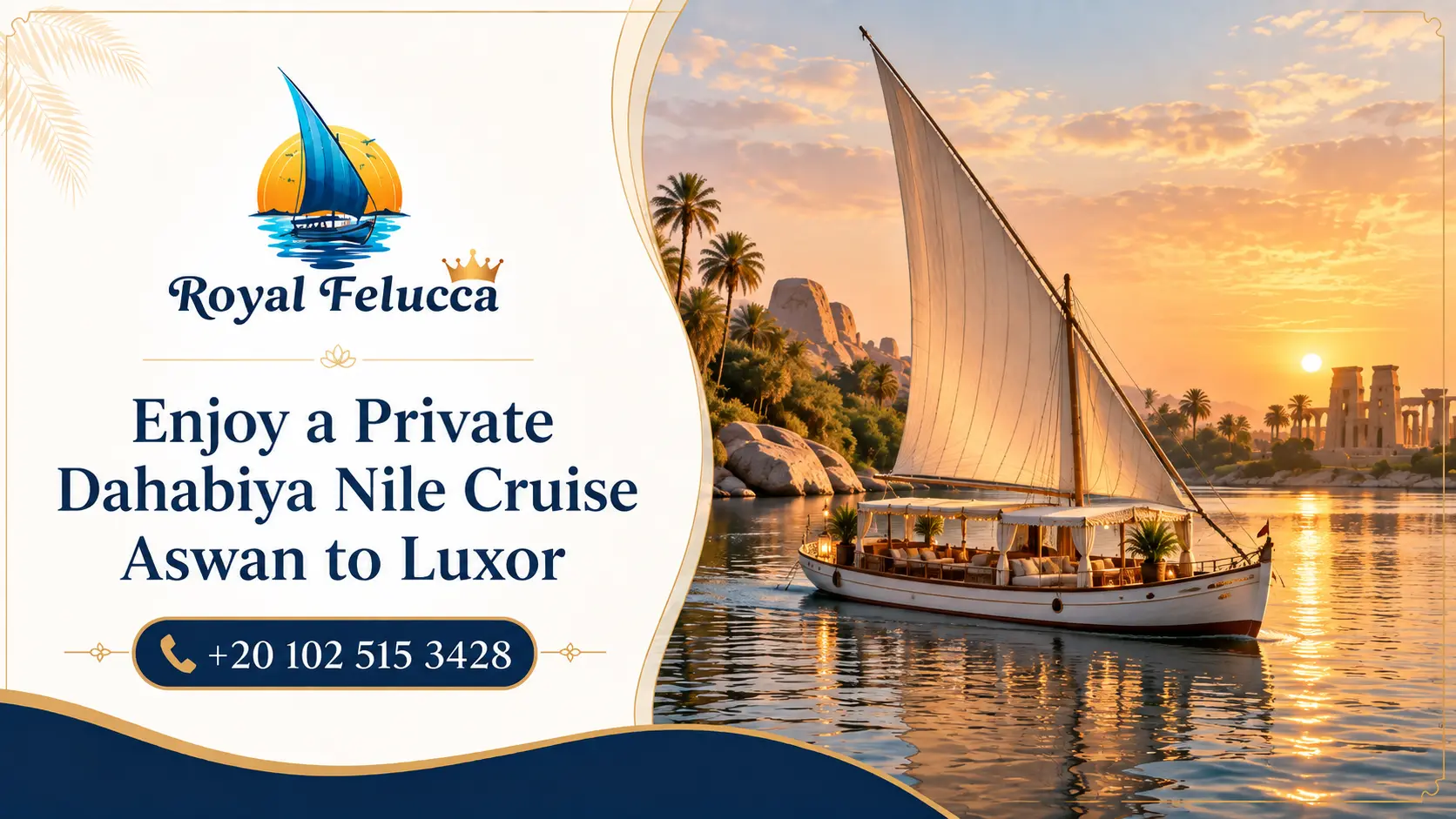
Royal Felucca’s dahabiya carries only twelve guests across six suites.
This creates a much more intimate atmosphere than a large cruise ship.
The suites combine traditional wooden character with refined details such as arched windows, cane headboards, hand-woven textiles, quality linens, and carefully considered amenities.
Guests can spend mornings visiting ancient temples, afternoons enjoying tea on the sundeck, and evenings dining beneath the stars.
For travelers comparing Nile cruise vs felucca but struggling to choose between comfort and intimacy, a dahabiya can provide an appealing balance.
Privacy: Which One Is Better?
Privacy is another important difference.
Large Nile cruise ships can carry many passengers, creating busy shared spaces, large excursion groups, and less personal interaction with the crew.
A private felucca offers the opposite experience.
The boat is designed around a much smaller group, allowing couples, families, or friends to enjoy their journey more privately.
This changes the atmosphere dramatically.
Conversations become easier.
Meals feel more personal.
The scenery receives more attention.
There is no need to compete with large numbers of travelers for space on deck.
For travelers who consider privacy one of their highest priorities, a private felucca can be particularly rewarding.
Which Option Offers More Relaxation?
Both experiences can be relaxing, but they provide different types of relaxation.
A cruise provides relaxation through convenience and comfort.
Many important arrangements are organized, allowing travelers to move between destinations without constantly planning transportation and accommodation.
A felucca provides relaxation through simplicity.
The pace is slower.
The surroundings are quieter.
The wind determines the movement of the boat.
There is time to watch the landscape without wondering what activity comes next.
For travelers trying to escape busy schedules and fast-paced daily life, this simplicity can become one of the strongest arguments in favor of a felucca.
Which Experience Is More Authentic?
Authenticity means different things to different travelers.
A well-designed Nile cruise can provide authentic cultural and historical experiences through expert guidance and thoughtfully selected destinations.
However, traditional felucca sailing provides a particularly direct connection with the river.
The boat moves according to the wind.
You spend significant time outdoors.
You see communities, farmers, fishermen, birds, villages, and landscapes from the water.
The experience is less separated from the environment.
For travelers who want to experience the natural rhythm of the Nile and traditional sailing itself, a felucca generally provides a stronger sense of authenticity.
Which Is Better for Exploring Ancient Temples?
Travelers primarily interested in seeing a large number of historical attractions may find a longer cruise-style journey more convenient.
The Nile connects many extraordinary archaeological destinations.
Luxor provides access to remarkable sites such as Karnak and the Valley of the Kings.
Edfu is home to the Temple of Horus.
Kom Ombo offers its distinctive riverside temple.
Aswan provides access to Philae and the unique landscapes of southern Egypt.
A structured Nile journey can bring these sites together efficiently.
A traditional felucca can also include selected temple visits, but the experience is generally more focused on the journey itself rather than covering the largest possible number of attractions.
Luxor and the Monumental Side of Ancient Egypt
Luxor is one of the most important destinations for travelers interested in ancient Egyptian history.
The city and surrounding region contain monumental temples, royal tombs, statues, and archaeological remains.
Karnak demonstrates the extraordinary scale of ancient Egyptian religious architecture.
The Valley of the Kings reveals royal tombs carved into the western desert.
For travelers who want Luxor to form a major part of their Nile journey, a dahabiya or broader cruise itinerary may be particularly suitable.
The journey can then continue along the Nile toward Edfu, Kom Ombo, and Aswan.
Edfu and the Temple of Horus
Edfu is another major historical destination along the river.
The Temple of Horus is one of the most impressive and well-preserved ancient temples in Egypt.
Its monumental entrance, courtyards, walls, inscriptions, and religious spaces provide travelers with an extraordinary opportunity to explore ancient Egyptian architecture.
With an Egyptologist guide, the visit becomes even more valuable.
The carvings and structures become connected to ancient beliefs, mythology, rituals, and rulers.
A Nile journey allows Edfu to become part of a continuous story rather than an isolated sightseeing stop.
Kom Ombo From the Nile
Kom Ombo is especially memorable when experienced as part of a river journey.
Its ancient temple stands close to the Nile and is associated with both Sobek and Horus.
The location creates a natural relationship between the archaeological site and the surrounding river landscape.
For travelers choosing a traditional felucca experience from Aswan toward Kom Ombo, this destination can become an important historical highlight of the journey.
Instead of moving directly from one attraction to another, the landscapes between Aswan and Kom Ombo become part of the experience.
Aswan: The Perfect Destination for Felucca Sailing
Aswan is particularly suited to traditional felucca experiences.
The Nile moves between beautiful islands, palm-covered shores, Nubian communities, granite landscapes, and desert scenery.
Traditional sails are part of the visual identity of the city.
From the water, travelers can experience locations such as Elephantine Island and the Nubian shores from a completely different perspective.
The quieter character of Aswan also suits the relaxed pace of traditional sailing.
For travelers who want a local and intimate Nile experience rather than a long sightseeing itinerary, an Aswan felucca trip can be an excellent choice.
Discover Nubian Culture by Felucca
One of the strongest reasons to choose a felucca around Aswan is the opportunity to experience Nubian culture.
Nubian communities form an important part of the identity of southern Egypt.
Their colorful architecture, traditions, hospitality, and relationship with the river create a distinctive cultural experience.
A carefully designed felucca journey can include opportunities to visit Nubian shores and communities.
This provides a contrast with archaeological sightseeing.
Instead of only learning about ancient Egypt, travelers also experience the living cultures of the Nile today.
Meals: How Do the Experiences Compare?
Dining differs significantly between large cruises and traditional feluccas.
On a cruise-style vessel, meals are usually served in organized dining areas as part of a structured daily routine.
On a private felucca, the setting can feel much more informal and closely connected to the landscape.
Royal Felucca’s traditional experience includes freshly prepared onboard meals.
Food can be enjoyed on the open deck while the river continues around you.
A meal becomes part of the journey.
On the Dahabiya Experience, full-board dining can be included while travelers enjoy a more refined onboard environment.
Both styles can be memorable, but the atmosphere is noticeably different.
Sunset: Which Experience Is Better?
The Nile is beautiful at sunset regardless of the boat you choose.
However, smaller vessels can provide a quieter way to experience it.
On a private felucca, travelers can sit on the open deck as the light begins to soften.
Palm trees become silhouettes.
The sky develops warmer colors.
Traditional sails appear against the evening light.
The Nile reflects the changing sky.
There is no need to search for a viewing point because the river surrounds you.
A smaller dahabiya can offer a similarly peaceful experience from its sundeck, while also providing greater onboard comfort.
Sleeping Experience: Cruise vs Felucca
Accommodation is one area where the experiences are very different.
A cruise or dahabiya provides dedicated cabins or suites.
Travelers have a defined private space where they can rest after sightseeing.
Royal Felucca’s dahabiya provides six refined suites with thoughtful details and premium comfort.
A traditional felucca offers a simpler sleeping experience.
Travelers can experience the open-air atmosphere of the Nile with bedding and linens provided as part of the journey.
For adventurous travelers, sleeping beneath the stars can become one of the most memorable elements of the trip.
For travelers who strongly prefer private indoor accommodation, the dahabiya is likely to be the better option.
Which One Is Better for Couples?
Both experiences can work wonderfully for couples.
The best choice depends on the type of romantic experience you want.
A dahabiya offers private suites, refined comfort, peaceful sailing, and dinners beneath the stars.
A private felucca offers simplicity, intimacy, open landscapes, and a closer connection with nature.
Couples planning a honeymoon or anniversary may prefer the additional comfort of the dahabiya.
Couples seeking a more adventurous and unconventional experience may prefer the private felucca.
Both allow travelers to avoid much of the crowding associated with larger cruise ships.
Which Is Better for Families?
Families should consider comfort, privacy, children’s ages, and preferred travel style.
A dahabiya can provide families with private accommodation and a more structured environment while maintaining smaller guest numbers than a large cruise vessel.
A private felucca provides a more adventurous experience.
Children can see traditional sailing, wildlife, villages, agricultural landscapes, and local life directly from the water.
Families who enjoy outdoor travel may find the felucca particularly memorable.
Those who prioritize private cabins and additional comforts may prefer a dahabiya.
Which Is Better for Photography?
Both experiences provide excellent photography opportunities.
However, a felucca has one major advantage: its slow movement.
Photographers have more time to notice scenes along the river.
Traditional sails, fishermen, palm trees, villages, birds, Nubian architecture, agricultural landscapes, and sunsets create endless subjects.
A dahabiya also provides excellent opportunities from its sundeck while covering a broader historical itinerary.
For photographers interested mainly in local life and landscapes, a felucca can be particularly rewarding.
For photographers who also want extensive archaeological content, the dahabiya may provide a better balance.
Which Experience Is Better if You Have Limited Time?
Travel time should play an important role in your decision.
If you only have a short period in Aswan and want to experience traditional sailing, a shorter private felucca journey around the city and Nubian shores may fit your schedule well.
If you want to travel across several major Upper Egyptian destinations, a longer Nile itinerary is more appropriate.
Traditional felucca sailing depends on wind conditions and should not be treated like a fast motorized transfer.
Travelers should therefore choose an itinerary that respects the natural character of sailing rather than trying to cover unrealistic distances within a short period.
Which Is Better for a Longer Journey?
For a longer exploration of Upper Egypt, travelers should consider the destinations they want to include.
A dahabiya can provide a particularly attractive combination of sightseeing, comfort, smaller guest numbers, and relaxed sailing.
Guests can explore historical destinations before returning to private suites and comfortable onboard spaces.
A multi-day traditional felucca journey offers something different.
Rather than focusing on broad geographic coverage, it provides more time immersed in the river environment.
The best choice depends on whether your priority is covering more historical destinations or experiencing the Nile itself more deeply.
Nile Cruise vs Felucca for Adventure Travelers
Adventure travelers may naturally be drawn toward the felucca.
Traditional sailing removes many elements associated with conventional luxury travel.
The environment is simpler.
The experience is more exposed to the natural rhythm of the river.
The journey feels less standardized.
Sleeping beneath the stars, waking to birdsong, enjoying fresh meals on deck, and moving with the wind create a sense of adventure that is difficult to reproduce on a conventional cruise.
For travelers who enjoy simplicity and outdoor experiences, this can be extremely rewarding.
Nile Cruise vs Felucca for Luxury Travelers
Travelers who prioritize premium comfort may prefer a dahabiya.
Royal Felucca’s dahabiya combines a traditional wooden character with elegant suites and thoughtful details.
Only twelve guests are accommodated across six suites, preserving privacy while providing greater comfort.
Guests can enjoy carefully prepared dining, scenic sailing, historical visits, and personalized service without sacrificing private accommodation.
This makes the dahabiya particularly appealing to travelers who want luxury without the atmosphere of a large commercial cruise ship.
What Is Included in a Royal Felucca Experience?
Royal Felucca’s traditional Felucca Experience can include a private felucca charter, onboard meals, an Egyptologist guide, transfers, temple entrances, bedding, and linens.
These inclusions allow travelers to focus on the experience instead of organizing every detail themselves.
The boat remains private.
Meals become part of the journey.
Historical visits can be supported by specialist guidance.
Transfers help connect different parts of the itinerary.
The experience is designed around traditional sailing while providing practical support throughout the journey.
What Is Included in the Dahabiya Experience?
The Royal Felucca Dahabiya Experience can include full-board dining, domestic flights, an Egyptologist guide, temple entrance fees, airport transfers, and in-suite amenities.
The dahabiya carries just twelve guests in six suites.
This combination provides a more complete travel experience for guests who want historical discovery, premium comfort, and a smaller vessel.
Instead of dealing with multiple travel arrangements independently, important elements can be organized within the journey.
This can make exploring Upper Egypt considerably easier.
When Is the Best Time for Either Experience?
October through April generally offers some of the most comfortable conditions for exploring Upper Egypt.
Temperatures during this period are better suited to temple visits and spending time outdoors.
Morning and evening light can also be particularly beautiful along the river.
For felucca travelers, comfortable outdoor conditions are especially important because much of the experience takes place on the open deck.
Dahabiya travelers also benefit from pleasant weather when relaxing on the sundeck or exploring archaeological sites.
Why Choose Royal Felucca?
Royal Felucca provides travelers with different ways to discover the Nile while maintaining the same emphasis on personal service and authentic hospitality.
With more than 14 years of sailing experience and over 2,400 guests welcomed, the team brings local knowledge to every journey.
The traditional felucca offers a private, wind-powered experience with no engine and no unnecessary rush.
Travelers can experience Nubian shores, freshly prepared meals, selected historical visits, peaceful nights, and the natural landscapes of Upper Egypt.
The dahabiya provides a more refined alternative with only twelve guests across six suites.
Carefully designed accommodation, premium linens, traditional details, scenic sailing, curated itineraries, and expert Egyptologist guidance create a comfortable but intimate experience.
Rather than forcing every traveler into the same type of journey, Royal Felucca offers different ways to experience the river according to your travel style.
So, Nile Cruise or Felucca: Which One Should You Choose?
Choose a more comfortable cruise-style or dahabiya journey if you want private accommodation, a wider selection of historical destinations, greater onboard comfort, and a more structured itinerary.
Choose a private felucca if you want traditional sailing, simplicity, privacy, outdoor living, Nubian culture, and a stronger connection with the natural rhythm of the Nile.
If you want elements of both, a dahabiya can be an excellent compromise.
It provides the intimacy and slower character associated with smaller Nile vessels while offering private suites and premium comfort.
Ultimately, there is no single option that is better for every traveler.
The better journey is the one that matches the way you want to experience Egypt.
Conclusion
The Nile cruise vs felucca decision is not simply about choosing between two types of boats.
It is about choosing how you want to experience the Nile.
A cruise-style journey offers greater comfort, structured sightseeing, and easier access to multiple historical destinations.
A traditional felucca provides simplicity, privacy, wind-powered sailing, local landscapes, and a deeper connection to the river itself.
A dahabiya brings many of these qualities together, offering intimate sailing with refined accommodation and carefully designed services.
For travelers fascinated by temples and looking to explore several major destinations comfortably, the dahabiya may be the stronger choice.
For travelers who want to slow down, experience Nubian shores, eat on the open deck, sleep beneath the stars, and move with the wind, the traditional felucca offers something truly distinctive.
With more than 14 years of sailing experience, personalized service, carefully curated itineraries, expert local guidance, premium comfort, and genuine Egyptian hospitality, Royal Felucca provides both refined and traditional ways to discover Upper Egypt.
Whichever experience you choose, the most important thing is allowing enough time to appreciate the Nile itself.
Because the best Nile journey is not only about reaching Luxor, Edfu, Kom Ombo, or Aswan.
It is about everything you experience on the river between them.