Nile Cruise vs Felucca and the Main Differences You Should Know
The Nile is much more than a river running through Egypt. For thousands of years, it has shaped cities, agriculture, transportation, traditions, and some of the world’s most remarkable ancient civilizations. Today, sailing along the Nile remains one of the most memorable ways to experience Upper Egypt, but travelers have very different options when deciding how to make that journey.
One of the most common comparisons is Nile cruise vs felucca.
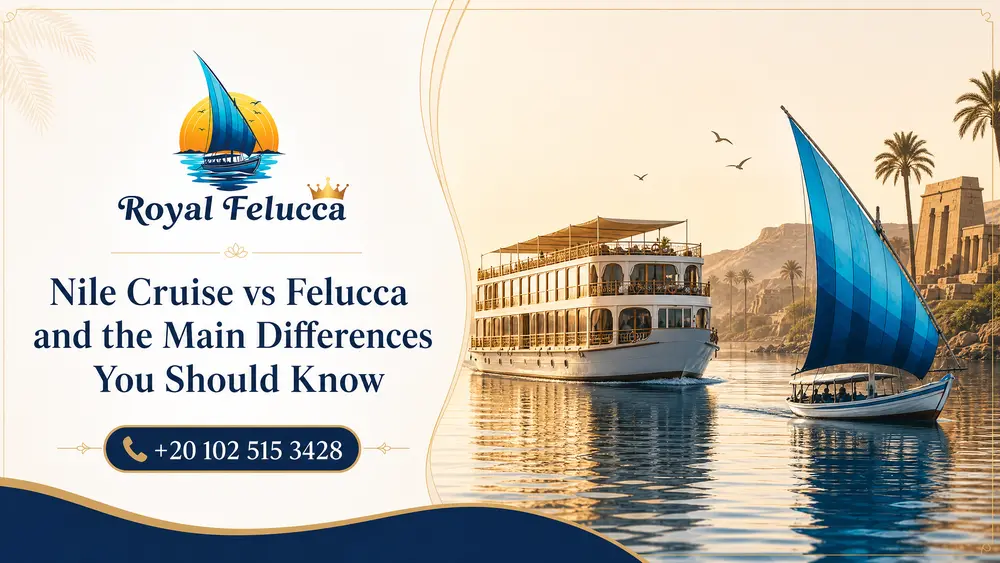
A Nile cruise usually provides greater onboard comfort, organized sightseeing, accommodation, and a structured route between important historical destinations. A traditional felucca offers something completely different: a smaller boat, wind-powered sailing, greater simplicity, privacy, and a much closer connection with the landscapes and everyday life surrounding the Nile.
Neither experience is automatically better.
The right choice depends on your travel style, available time, comfort expectations, interest in ancient history, preferred level of privacy, and how deeply you want the river itself to become part of your trip.
Royal Felucca creates different ways to experience the Nile, from refined dahabiya journeys to traditional private felucca sailing. With more than 14 years of sailing experience and over 2,400 guests welcomed, Royal Felucca combines local knowledge, authentic Egyptian hospitality, carefully planned experiences, and a relaxed approach to discovering Upper Egypt.
Understanding the main differences before booking can help you choose the Nile journey that best matches the experience you want in Egypt.
About the Nile Cruise and Felucca Experience
Both Nile cruises and traditional feluccas allow travelers to discover Egypt from its most famous river, but they approach that journey in very different ways.
A conventional Nile cruise is usually built around comfort and organized travel. Your accommodation moves with you as you visit several destinations, reducing the need to change hotels and arrange transportation every day.
A felucca places much greater emphasis on traditional sailing.
The boat moves with the wind rather than relying on the constant power of an engine. The atmosphere is simpler, quieter, and more connected to the river.
Royal Felucca also offers a dahabiya experience, providing travelers with an alternative between these styles. A dahabiya preserves the intimacy and slower atmosphere of smaller-vessel Nile travel while providing private suites and premium comfort.
This means the decision is not simply between luxury and simplicity.
It is about choosing how you want to experience the Nile.
What Is a Nile Cruise?
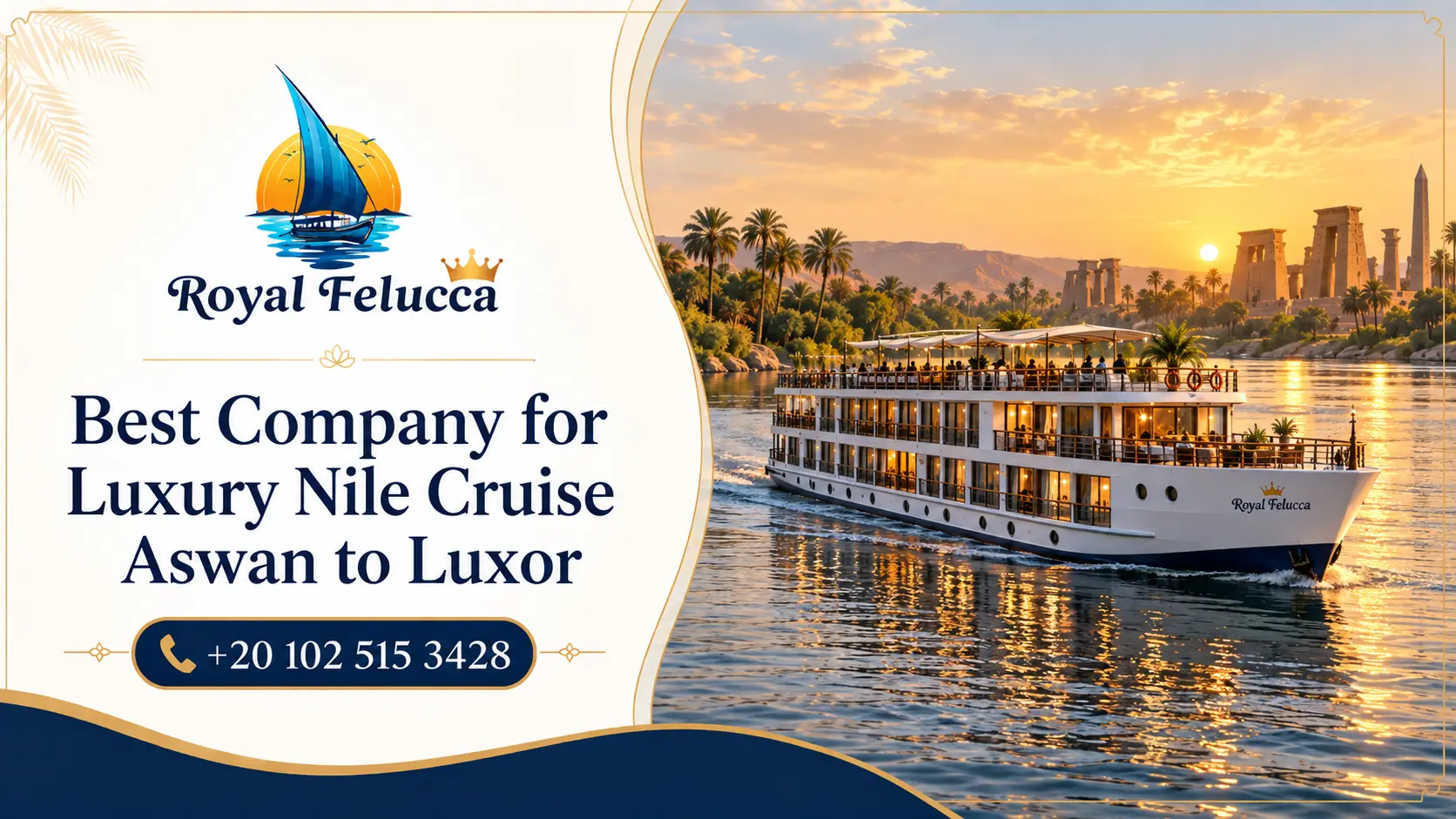
A Nile cruise is generally a multi-day journey combining transportation, accommodation, meals, and sightseeing.
Many cruise itineraries connect important destinations across Upper Egypt, allowing travelers to explore archaeological sites during the day and return to the vessel afterward.
This makes the experience convenient.
Instead of checking into several hotels, guests can remain settled onboard while traveling through the Nile Valley.
The river becomes both transportation and scenery.
Travelers can visit ancient monuments, return for meals, relax on deck, and continue toward another destination without constantly managing luggage and road transfers.
For people who want to explore several historical destinations comfortably, this can be one of the strongest advantages of a cruise.
What Is a Felucca?
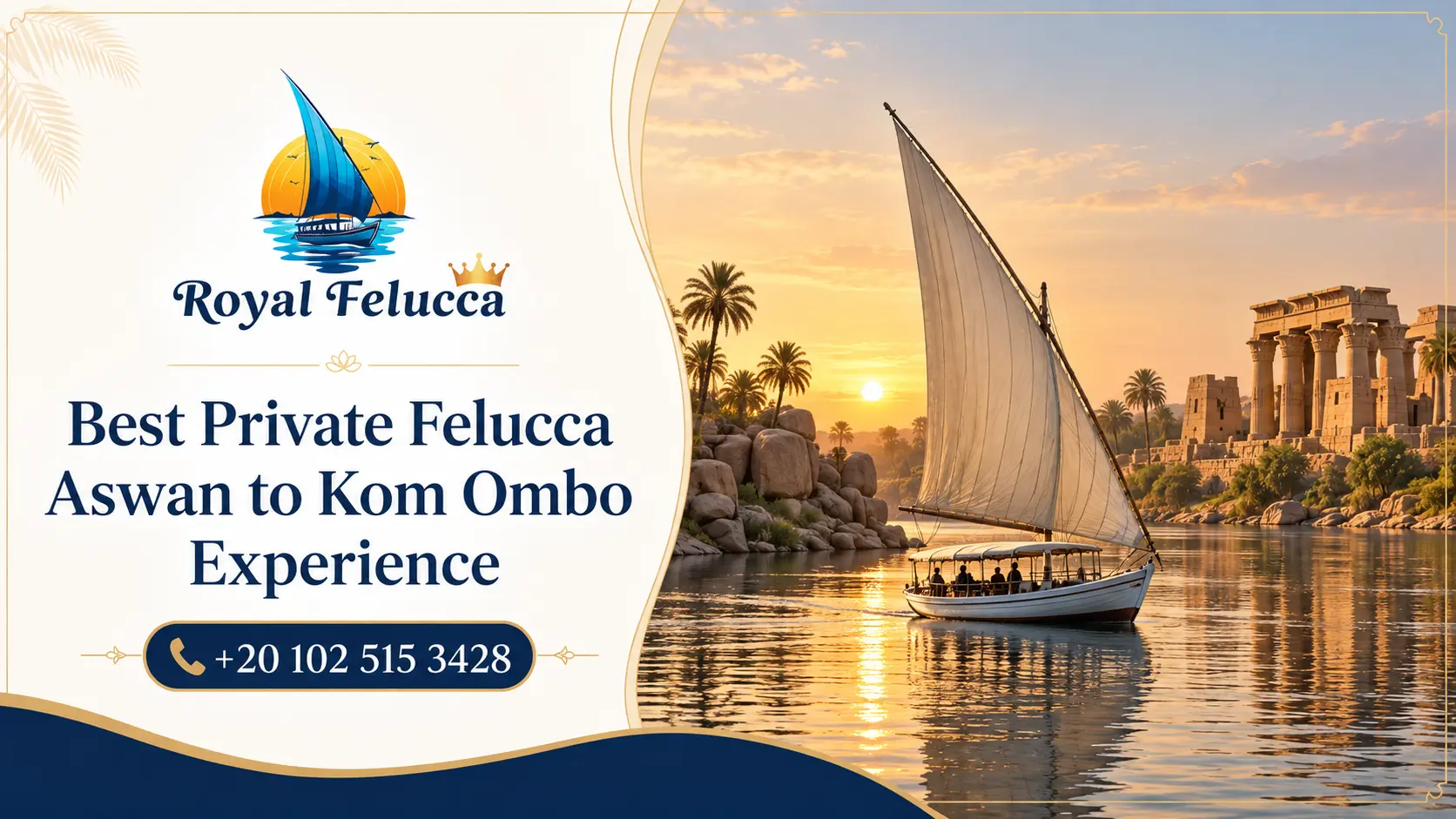
A felucca is a traditional Egyptian sailing boat that has become one of the most recognizable sights along the Nile, particularly around Aswan.
Its defining characteristic is its relationship with the wind.
Traditional feluccas do not rely on an engine to maintain a fixed cruising schedule. They sail according to natural conditions.
This produces a completely different atmosphere.
There is less mechanical noise.
The journey is slower.
Travelers spend more time outdoors.
The landscape feels closer.
Instead of viewing the Nile through the windows of a large vessel, you are directly surrounded by it.
Royal Felucca’s traditional private experience can combine sailing with onboard meals, Nubian landscapes, selected historical visits, an Egyptologist guide, transfers, temple entrances, bedding, and linens according to the chosen journey.
Nile Cruise vs Felucca: The Most Important Difference
The biggest difference is not necessarily the size of the boat.
It is the philosophy of the journey.
A Nile cruise generally uses the river as a comfortable route connecting important destinations.
A felucca makes the river itself a much larger part of the experience.
On a cruise, travelers may think about where they are arriving next.
On a felucca, they often begin thinking more about what they are seeing right now.
Palm trees beside the water.
Farmers working near the river.
Traditional villages.
Birdlife.
Fishing boats.
Desert landscapes beyond the narrow green agricultural strip.
Traditional sailing encourages travelers to pay greater attention to these quieter parts of Egypt.
Comfort Is One of the Clearest Differences
Comfort is an important consideration when comparing the two experiences.
A Nile cruise usually provides cabins or suites, indoor spaces, dedicated dining areas, and more conventional travel facilities.
A traditional felucca is intentionally simpler.
Much of the experience takes place on the open deck, with the emphasis placed on sailing, scenery, local atmosphere, and outdoor living rather than hotel-style facilities.
Travelers should therefore think carefully about their expectations.
If having a private indoor suite and additional amenities is essential, a traditional felucca may not be the right choice for an extended journey.
If simplicity feels exciting rather than uncomfortable, a private felucca may provide an experience that is difficult to recreate elsewhere.
A Dahabiya Provides a Middle Ground
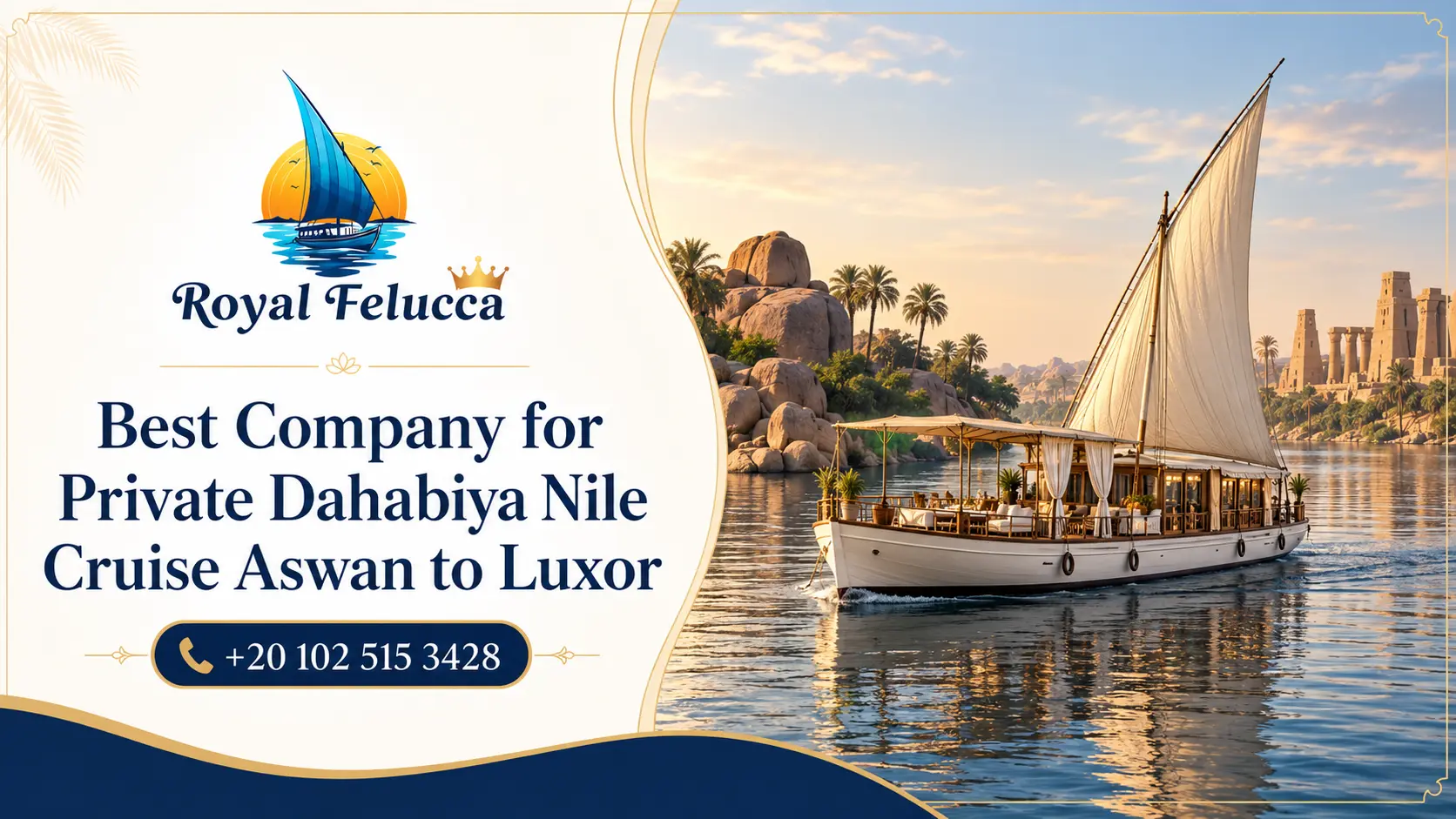
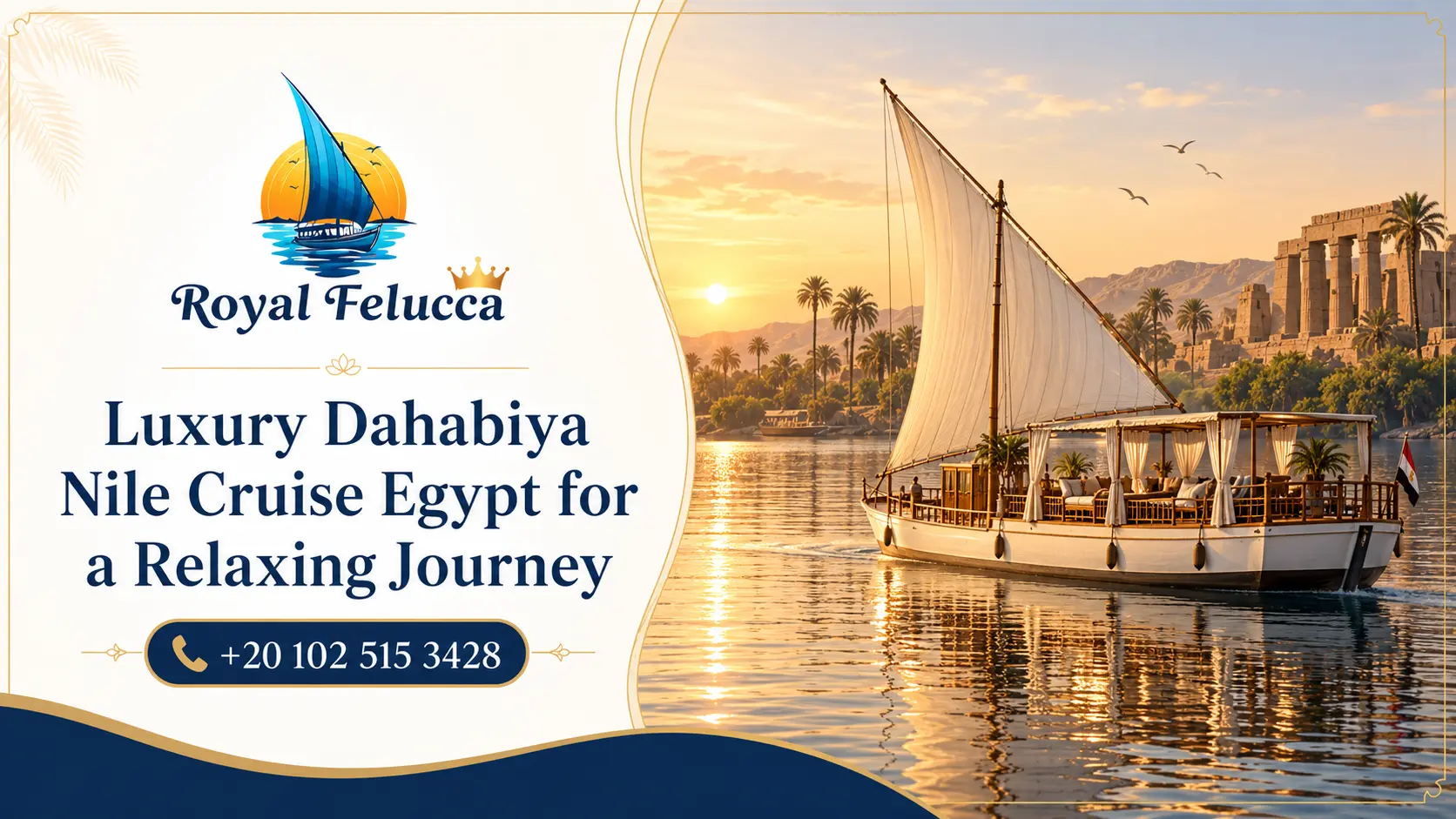
Travelers who want traditional Nile character without sacrificing premium comfort may prefer a dahabiya.
Royal Felucca’s dahabiya accommodates only twelve guests across six suites.
This small capacity creates an intimate environment while still allowing guests to enjoy private accommodation.
The suites feature traditional and refined elements such as arched windows, cane headboards, hand-woven textiles, comfortable linens, and thoughtfully selected amenities.
Guests can spend mornings discovering archaeological sites, afternoons enjoying tea on the sundeck, and evenings dining beneath the stars.
For travelers considering Nile cruise vs felucca but wanting aspects of both, a dahabiya can provide an attractive alternative.
Privacy Can Be Very Different
Privacy is another major distinction.
Large cruise vessels may carry many guests.
Shared lounges, dining spaces, decks, and excursions can therefore feel busy.
A private felucca provides a much smaller and more personal environment.
The experience is centered around you and the people traveling with you.
Couples can enjoy the river together.
Families can spend time without navigating large groups.
Friends can share meals and evenings privately.
Even a small dahabiya provides considerably more intimacy than a large commercial cruise.
Royal Felucca’s dahabiya carries only twelve guests, helping create quieter shared spaces and more personalized service.
The Pace of Travel Changes Completely
A conventional cruise typically follows a structured schedule.
Specific destinations need to be reached at particular times.
Excursions take place according to planned itineraries.
Meals and activities are generally organized around that structure.
A traditional felucca follows a more natural rhythm.
The wind matters.
The river matters.
Sailing conditions matter.
This means felucca travel should not be treated like a fast transfer between cities.
Travelers who choose this style should appreciate the slower pace rather than seeing it as a disadvantage.
For many guests, slowing down becomes one of the highlights.
A Nile Cruise Is Better for Covering More Historical Destinations
If your main goal is seeing several major archaeological destinations within a limited amount of time, a structured Nile journey can be particularly effective.
Upper Egypt contains extraordinary historical sites across multiple locations.
Luxor provides monumental temples and royal tombs.
Edfu contains the remarkable Temple of Horus.
Kom Ombo presents its distinctive riverside temple.
Aswan combines archaeological attractions with islands, Nubian culture, and beautiful Nile scenery.
A structured cruise or dahabiya itinerary makes it easier to combine several of these destinations into one journey.
For history-focused travelers, this broader geographical reach can be extremely valuable.
A Felucca Is Better for Experiencing the River Slowly
A felucca offers a different type of discovery.
Instead of focusing on covering the greatest possible distance, the experience gives travelers time to notice what exists between major destinations.
Villages that might otherwise be ignored become interesting.
Agricultural landscapes become part of the journey.
Daily life on the river becomes visible.
Traditional sailing becomes an experience in itself.
The slower pace changes your relationship with the destination.
The question is no longer simply, “What temple are we visiting next?”
It becomes, “What are we experiencing right now?”
Luxor Shows the Historical Strength of a Longer Nile Journey
Luxor is one of the most important destinations in any Upper Egypt itinerary.
The city provides access to some of ancient Egypt’s most remarkable monuments.
Karnak reveals monumental religious architecture developed over centuries.
The Valley of the Kings provides insight into royal burial traditions and ancient beliefs surrounding the afterlife.
For travelers whose priority is visiting these major historical sites before continuing through Upper Egypt, a cruise-style or dahabiya itinerary may be more appropriate than a traditional short-distance felucca experience.
Edfu Adds Another Chapter of Ancient Egypt
Further along the Nile, Edfu provides another extraordinary historical experience.
The Temple of Horus is one of the best-preserved ancient temples in Egypt.
Its monumental entrance, courtyards, columns, chambers, and detailed inscriptions give visitors an impressive understanding of ancient Egyptian temple architecture.
An Egyptologist guide can make these visits far more meaningful by explaining the mythology, religious practices, rulers, and symbolism represented throughout the site.
When Edfu is experienced within a broader Nile itinerary, the temple becomes part of one continuous historical journey.
Kom Ombo Works Beautifully With Both Styles
Kom Ombo is particularly interesting because it can complement different forms of Nile travel.
The ancient temple stands close to the river and is famous for its unusual association with both Sobek and Horus.
Its position beside the Nile makes it especially atmospheric for travelers arriving as part of a river journey.
Kom Ombo can form part of a longer structured Nile itinerary, but it can also be connected with a traditional felucca journey from the Aswan region when enough time is allowed for wind-powered sailing.
This makes it an excellent meeting point between ancient history and the slower landscapes of the Nile.
Aswan Is Perfect for Traditional Felucca Sailing
If there is one destination particularly associated with traditional feluccas, it is Aswan.
The Nile around Aswan flows through a landscape of islands, palms, granite formations, Nubian communities, traditional boats, and surrounding desert.
A felucca allows travelers to move directly through this scenery.
Elephantine Island can be seen from the water.
Nubian shores appear along the journey.
Smaller boats move between river channels.
The city gradually becomes quieter as you sail farther from the busy shoreline.
For travelers who mainly want to experience traditional sailing rather than cover a long archaeological route, Aswan provides an ideal setting.
A Felucca Can Bring You Closer to Nubian Culture
Ancient history is only one part of Upper Egypt.
Southern Egypt is also home to Nubian communities whose identity, architecture, hospitality, traditions, and everyday life remain closely connected with the Nile.
Traditional felucca sailing provides a natural way to experience this side of the region.
Travelers can pass Nubian shores and, depending on the journey, spend time discovering local communities.
These cultural experiences provide valuable balance.
The temples reveal Egypt’s extraordinary ancient past.
Nubian communities reveal the living cultures that continue beside the river today.
The Dining Experience Is Different
Food forms part of both experiences, but the atmosphere can be very different.
On a conventional Nile cruise, meals are usually served in designated dining spaces according to an organized schedule.
A smaller dahabiya can offer a more intimate dining environment while maintaining full-board comfort.
Royal Felucca’s Dahabiya Experience can include full-board dining, allowing guests to enjoy meals as part of the complete journey.
On the traditional felucca, food can be prepared fresh onboard and served in a much simpler open-deck environment.
The Nile remains directly around you.
The setting feels informal and personal.
For many travelers, this simplicity becomes one of the most memorable aspects of the experience.
Sleeping Arrangements Are a Major Difference
The way you sleep is one of the most practical differences to consider.
A conventional Nile cruise usually provides a private cabin.
A dahabiya can provide a refined private suite within a smaller vessel.
Royal Felucca’s dahabiya has six suites, giving guests a comfortable place to rest after historical excursions.
Traditional felucca travel is much simpler.
The open-air environment is part of the experience, and bedding and linens can be provided for longer journeys.
For adventurous travelers, sleeping beneath the stars beside the Nile can be unforgettable.
For guests who strongly prefer private indoor accommodation, a dahabiya or conventional cruise is likely to be more suitable.
The Evening Atmosphere Is Different Too
Evening is one of the most beautiful times to experience the Nile.
On larger cruise vessels, evenings may include organized onboard activities and shared entertainment.
On smaller vessels, the river itself often provides the atmosphere.
A dahabiya gives guests the opportunity to dine beneath the stars, enjoy conversation, and appreciate the quieter surroundings.
A traditional felucca offers an even simpler experience.
The river becomes still.
Distant villages become quieter.
The sky becomes more prominent.
There may be little more than conversation, lantern light, and the sound of the Nile.
For travelers who value quiet over entertainment, this can be a major advantage.
Sunset Feels Especially Personal on a Smaller Boat
Sunset is beautiful from almost any Nile vessel, but the experience can feel more intimate from a smaller boat.
There are fewer distractions.
The changing light becomes the focus.
Palm trees turn into silhouettes.
Traditional sails appear against the evening sky.
Warm colors reflect on the river.
A private felucca allows travelers to experience this moment with their own group.
A dahabiya offers a similarly peaceful atmosphere from the sundeck while providing greater comfort.
Which Option Is Better for Couples?
Couples can enjoy both experiences, but their priorities matter.
A dahabiya can be ideal for couples who want privacy, elegant accommodation, historical sightseeing, comfortable dining, and relaxed time together.
A private felucca may appeal to couples who prefer something simpler and more adventurous.
Traditional sailing, open landscapes, sunset, meals on deck, and evenings beneath the stars create a naturally romantic atmosphere.
Honeymooners or anniversary travelers may prefer the additional comfort of the dahabiya.
Couples who prioritize authenticity and outdoor adventure may find the felucca more memorable.
Which Option Is Better for Families?
Families should consider the ages of children and their comfort expectations.
A cruise or dahabiya provides more conventional accommodation, which can make longer journeys easier for some families.
The family can remain settled onboard while moving between historical destinations.
A private felucca offers a more adventurous alternative.
Children can watch traditional sailing, birds, villages, farms, and local river life directly from the deck.
Families that enjoy outdoor travel may appreciate this simplicity.
Those who prioritize private suites and more structured facilities may prefer a dahabiya.
Which Option Is Better for Friends?
Groups of friends can also benefit from smaller Nile experiences.
A private felucca allows the journey to belong entirely to the group.
Meals feel personal.
Time on the river becomes shared.
There is space for conversation without strangers surrounding you.
A dahabiya provides another attractive option when the group wants additional comfort and private accommodation.
The best choice depends on whether the group values traditional simplicity or premium facilities more strongly.
Which Is Better for Photography?
Both experiences offer excellent opportunities for photographers.
A structured Nile itinerary can provide access to major archaeological sites while also offering river landscapes from the deck.
A traditional felucca is particularly effective for photographing everyday life and scenery because it moves slowly.
Photographers have more time to observe changing light.
Villages.
Traditional boats.
Birdlife.
Farmers.
Palm trees.
Nubian architecture.
River reflections.
Sunsets.
For travelers focused primarily on natural landscapes and local life, the felucca can be especially rewarding.
For those wanting a wider mix of temples and scenery, the dahabiya may provide a better balance.
Which Is Better for Travelers With Limited Time?
If your time in Upper Egypt is limited and your priority is visiting several important historical attractions, a structured Nile itinerary may make better use of your schedule.
If you are staying in Aswan and simply want to experience traditional sailing for several peaceful hours, a shorter felucca experience can fit naturally into your itinerary.
The important point is not to expect wind-powered sailing to operate according to the same timetable as motorized transportation.
Traditional felucca journeys require respect for natural conditions.
Longer distances should be given enough time.
Which Is Better for Slow Travelers?
Travelers who actively want to slow down may find the felucca particularly appealing.
There is something fundamentally different about allowing wind and water to influence your day.
You cannot treat every hour as something that needs to be optimized.
This creates space.
Space to read.
Space to talk.
Space to watch.
Space to photograph.
Space to do nothing.
For many people living busy modern lives, this becomes a form of luxury that is more valuable than elaborate facilities.
Which Is Better for Luxury Travelers?
Luxury travelers do not necessarily need to choose a large cruise ship.
A small dahabiya can provide a different definition of luxury.
Privacy becomes part of the experience.
Fewer guests create quieter shared spaces.
Personalized service becomes easier.
Private suites offer comfort.
Expert guiding adds intellectual depth.
Carefully designed itineraries protect time for relaxation.
Royal Felucca’s six-suite dahabiya is designed around this style of intimate travel.
Which Is Better for Adventure Travelers?
Travelers who love outdoor experiences, simplicity, and unconventional travel may naturally prefer a felucca.
The boat depends on the wind.
The river determines the rhythm.
The experience takes place close to nature.
On longer journeys, evenings and sleeping arrangements can be much simpler than those aboard conventional cruise vessels.
For the right traveler, this simplicity is not something missing from the experience.
It is exactly what makes the experience worthwhile.
How the Level of Service Can Differ
Service is another important area to consider.
Large vessels may have extensive staff but must serve many passengers.
Smaller boats have fewer guests, making interactions more personal.
Royal Felucca focuses on authentic, unhurried Egyptian hospitality.
The intention is to create an experience where travelers feel looked after without making the journey overly formal.
Personalized service can also help align the itinerary with guest interests and preferred rhythm.
For many travelers, this type of attention contributes more to luxury than the size of the boat.
Expert Egyptologist Guidance Adds Depth
Whichever style of travel you choose, expert historical guidance can significantly improve your experience of Upper Egypt.
Ancient temples are filled with stories that are not always obvious.
Inscriptions refer to rulers, gods, battles, ceremonies, and religious beliefs.
Architectural layouts were created with specific purposes.
An Egyptologist can connect these details and help travelers understand the civilization behind the monuments.
Royal Felucca experiences can include Egyptologist guidance, ensuring that historical discovery remains an important part of the journey.
What Can Be Included in a Dahabiya Experience?
Royal Felucca’s Dahabiya Experience can include full-board dining, domestic flights, an Egyptologist guide, temple entrance fees, airport transfers, and in-suite amenities depending on the selected journey.
Bringing these services together provides convenience.
Travelers spend less time organizing logistics and more time enjoying Upper Egypt.
The combination of historical sightseeing, refined accommodation, small guest numbers, and personalized service creates a very different experience from a standard large-vessel cruise.
What Can Be Included in a Private Felucca Experience?
The traditional Royal Felucca Experience can include a private felucca charter, freshly prepared onboard meals, an Egyptologist guide, transfers, temple entrance fees, bedding, and linens.
The emphasis remains on simplicity and traditional sailing while important practical elements are organized for the traveler.
This makes it possible to enjoy a more authentic experience without having to arrange every detail independently.
Cost Should Be Compared With the Experience
Price is important, but comparing a Nile cruise and a private felucca solely by cost can be misleading.
The experiences are fundamentally different.
The number of guests differs.
Accommodation differs.
Sailing style differs.
Dining can differ.
The route can differ.
The level of privacy differs.
Before comparing prices, travelers should understand what each journey includes and what kind of experience they are purchasing.
The cheapest option is not automatically the best value.
The most expensive option is not automatically the right one either.
When Is the Best Time to Experience the Nile?
October through April generally provides comfortable conditions for exploring Upper Egypt.
Temperatures during these months are better suited to archaeological visits and spending time outdoors.
This is particularly important for felucca travelers because much of the traditional sailing experience happens on the open deck.
Dahabiya guests also benefit from comfortable conditions while relaxing on the sundeck or visiting historical sites.
The light around morning and sunset can be especially beautiful during a Nile journey.
Why Choose Royal Felucca?
Royal Felucca offers travelers different ways to discover the Nile according to their travel style.
With more than 14 years of sailing experience and over 2,400 guests welcomed, the team combines knowledge of Upper Egypt with personalized service and authentic Egyptian hospitality.
For travelers seeking refined comfort, the dahabiya provides six carefully designed suites and accommodation for just twelve guests.
This creates a quieter, more intimate alternative to large commercial cruise ships.
For travelers seeking something more traditional, the private felucca provides wind-powered sailing without an engine or unnecessary rush.
Nubian shores, local landscapes, fresh onboard meals, and carefully selected cultural and historical experiences become part of the journey.
Expert Egyptologist guidance can add depth to temple visits.
Transfers and entrance arrangements can help simplify logistics.
Most importantly, Royal Felucca treats the Nile as more than a transportation route.
The river itself is part of the experience.
Nile Cruise vs Felucca: How Should You Decide?
The best way to decide is to think about the experience you want rather than beginning with the boat.
Choose a cruise-style or dahabiya journey when you want private accommodation, greater comfort, a broader archaeological itinerary, organized services, and easier movement between several important destinations.
Choose a private felucca when you want traditional wind-powered sailing, a simpler outdoor experience, greater privacy, Nubian culture, river landscapes, and a slower rhythm.
Choose a dahabiya if you want the intimacy of smaller-vessel sailing combined with private suites and premium comfort.
There is no universal winner.
The right choice is the one that reflects your priorities.
Conclusion
The Nile cruise vs felucca comparison is ultimately about two very different approaches to discovering Egypt.
A Nile cruise offers convenience, structured sightseeing, comfortable accommodation, and the ability to connect several major historical destinations within one journey.
A traditional felucca offers intimacy, wind-powered sailing, simplicity, privacy, and a stronger connection with the natural and cultural landscapes of the Nile.
A dahabiya sits between these experiences, combining smaller guest numbers and a quieter river atmosphere with refined suites and premium comfort.
For travelers who want to experience Luxor, Edfu, Kom Ombo, Aswan, and other significant historical destinations within a comfortable journey, a dahabiya or cruise-style itinerary can provide the right balance.
For travelers whose strongest memories are likely to come from Nubian shores, open-deck meals, traditional sailing, sunsets, villages, and moving slowly with the wind, a private felucca can provide something extraordinary.
With more than 14 years of sailing experience, over 2,400 guests welcomed, personalized service, expert local knowledge, carefully curated journeys, and authentic Egyptian hospitality, Royal Felucca offers travelers different ways to discover the Nile according to the experience they truly want.
The most important question is not simply whether a Nile cruise or felucca is better.
It is which one is better for you.
Because when the right boat, itinerary, pace, and style come together, the Nile becomes much more than the route through Upper Egypt.
It becomes one of the most unforgettable parts of the entire journey.